How Humpback Whales Use Their Long Pectoral Fins
Humpback whales are famous for their enormous bodies, spectacular breaches, and unusually long pectoral fins. These powerful marine mammals have front limbs that look very different from the arms of land mammals, yet they retain the same basic underlying skeletal arrangement.
Their pectoral fins are among the most distinctive features of the species. They help humpback whales maneuver through the water, adjust their orientation, and perform a variety of movements that are fascinating to observe.
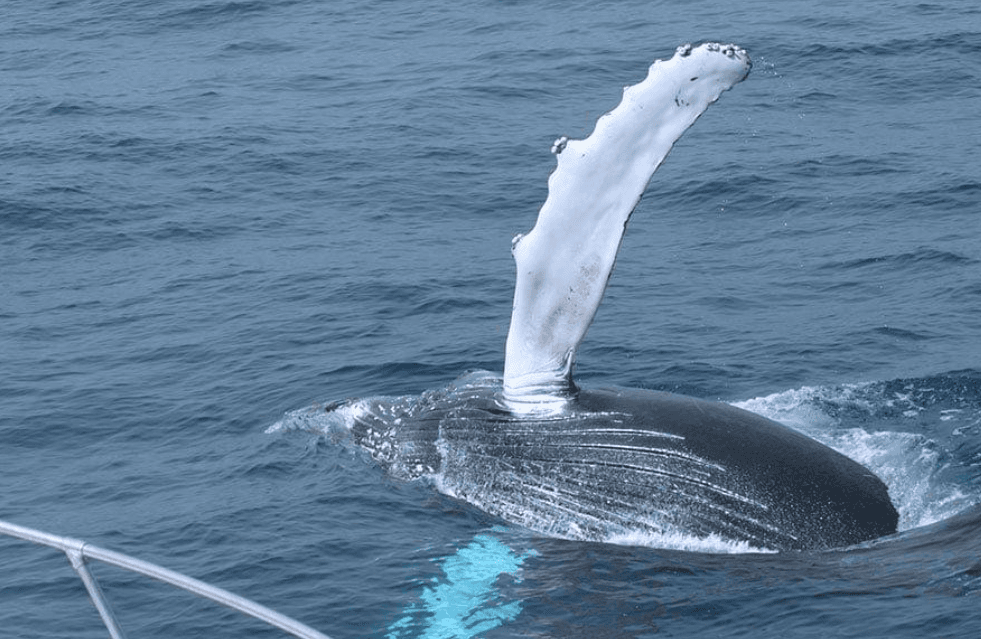
During whale watching in Samaná Bay, Dominican Republic, visitors may see a whale lift a fin above the surface, roll sideways, or extend its fins while swimming. Understanding the purpose of these movements makes each encounter more informative.
What Are Humpback Whale Pectoral Fins?
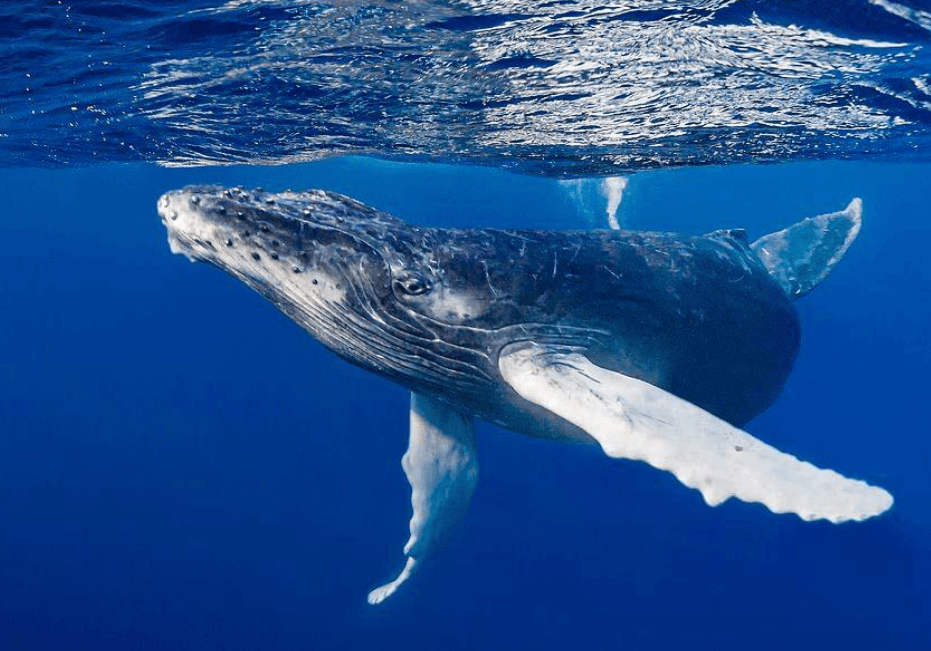
Pectoral fins are the paired front limbs located on either side of a humpback whale's body. They are sometimes called flippers.
Unlike the broad, horizontal tail flukes that provide much of a whale's forward propulsion, pectoral fins are positioned along the sides of the body and help control movement through the water.
Humpback whales have exceptionally long pectoral fins relative to their body size. These fins can reach approximately one-third of the whale's body length, making them a distinctive characteristic of the species.
Their shape, flexibility, and position allow them to influence how water flows around the animal as it swims.
The fins also have a skeletal structure inherited from the evolutionary history of mammals. Inside each fin are bones corresponding to the upper arm, forearm, wrist, and digits, although their arrangement is adapted for life in the ocean.
How Do Pectoral Fins Help Humpback Whales Steer?
One important function of the pectoral fins is maneuvering.
As a humpback whale moves through the water, changing the position or angle of its fins can alter the forces acting on its body. These adjustments can help it turn, change direction, or control its orientation.
For example, a whale may adjust its fins while swimming around another animal, changing its position near the surface, or maneuvering through a group of whales.
Water resistance and lift acting on the fins contribute to these movements. The exact effect depends on the fin's position, the whale's speed, and the direction in which it is moving.
The fins work together with the whale's body movements and tail flukes. Steering is not performed by one body part in isolation; several structures contribute to coordinated movement.
This combination of control and propulsion allows a large whale to perform movements that may appear surprisingly agile.
Why Are Humpback Whale Fins So Long?
Humpback whales have proportionally longer pectoral fins than many other whale species. Their unusual length is one of the most recognizable features of their anatomy.
Long fins provide a substantial surface area that can interact with surrounding water. This can influence maneuverability and hydrodynamic forces during swimming.
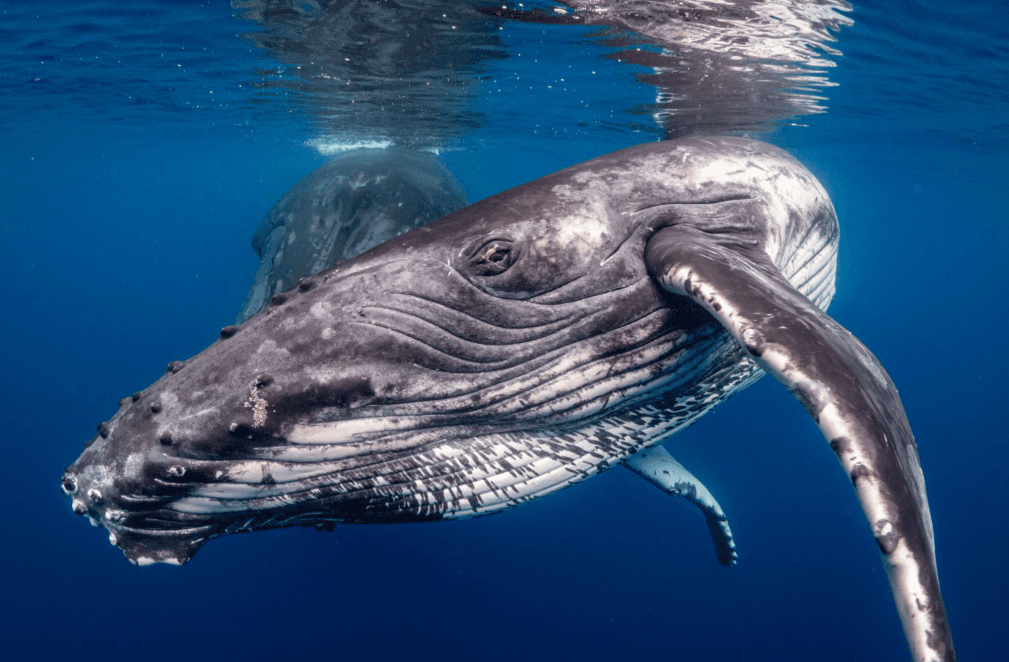
The fins also have specialized features along their leading edges, including irregular bumps known as tubercles. These structures have attracted scientific interest because they influence water flow around the fins.
Research into tubercled surfaces has helped scientists investigate how fin shape affects hydrodynamic performance. However, it is important not to assume that every benefit has been completely explained or that the same effects apply identically in every swimming condition.
The distinctive design of humpback whale fins reflects the combined effects of evolution, anatomy, and the physical demands of moving through water.
What Are the Bumps on a Humpback Whale's Fins?
If you look closely at a humpback whale's pectoral fin, you may notice rounded bumps along its leading edge.
These are called tubercles. They are natural anatomical structures rather than random lumps or signs of injury.
Tubercles influence how water moves around the fin. Engineers and researchers have studied similar shapes to understand how leading-edge design can affect lift, drag, and performance in flowing fluids.
The presence of tubercles is particularly interesting because conventional aircraft wings and many engineered fins have relatively smooth leading edges.
Humpback whales demonstrate that biological structures can use different designs to achieve effective performance in their environments.
Nevertheless, the precise contribution of tubercles depends on the operating conditions, and scientists continue to investigate the hydrodynamic effects of these structures.
How Do Pectoral Fins Help With Balance?
A humpback whale's body is large, but it still needs to control its orientation as it moves through the ocean.
Pectoral fins can contribute to stability by changing the forces acting on either side of the body. Adjustments to their angle and position may help the whale control rolling and other aspects of its orientation.
For example, when a whale rolls to one side, its fins may move into different positions as part of the overall maneuver.
The fins do not act as independent balancing devices. The whale coordinates fin movements with its body, tail, and other structures to maintain or change its orientation.
These adjustments are especially interesting when a whale performs a turn or moves close to the surface, where observers may see a fin appear above the water.
Why Do Humpback Whales Lift Their Fins Above the Water?
One behavior that attracts attention during whale watching is pectoral fin slapping.
A humpback whale may raise a fin and bring it down onto the water, creating a splash. This behavior is sometimes called a pectoral fin slap.
Scientists have observed this and other surface behaviors in different contexts, including social interactions. However, a fin slap does not have one universally established meaning.
Depending on the situation, the behavior may be associated with communication, social activity, or other functions that are not always easy to determine from a brief observation.
A whale may also expose a fin while rolling or changing its orientation, without necessarily performing a deliberate slap.
Visitors should therefore enjoy these displays without assuming that every movement is a message directed at nearby boats or people.
Can Humpback Whales Use Their Fins During Social Interactions?
Humpback whales sometimes interact at close range, particularly during breeding-season activity or other social encounters.
Their pectoral fins may be visible as individuals change positions, turn, or swim near one another. Fin movements form part of the broader range of body movements used during these encounters.
However, the meaning of a particular movement depends on context. A fin extended beside another whale does not automatically indicate aggression, affection, or a specific social intention.
Researchers consider the entire encounter, including the positions and movements of the animals, when studying whale behavior.
For whale watchers in Samaná Bay, observing the relationship between fin movement and the whale's overall body position can be more informative than trying to assign a fixed meaning to each action.
What Is the Difference Between Pectoral Fins and Tail Flukes?
Both structures are important for movement, but they have different shapes and primary functions.
Pectoral fins: These paired front limbs help with maneuvering, steering, and controlling orientation in the water.
Tail flukes: The broad, horizontal tail provides much of the thrust used for forward swimming. Moving the tail up and down pushes water backward and moves the whale forward.
A humpback whale may lift its tail flukes above the surface before a deep dive. It may also display its pectoral fins during a turn, roll, or surface behavior.
Recognizing these differences helps visitors understand how different body parts contribute to swimming.
Can Visitors See Pectoral Fin Movements in Samaná Bay?
Samaná Bay is a well-known seasonal destination for North Atlantic humpback whales. During the breeding season, visitors may observe whales surfacing, swimming, diving, and displaying different types of surface behavior.
Pectoral fin movements are not guaranteed on every trip. A whale may keep its fins underwater throughout an encounter, while another may roll or lift a fin near the surface.
If a fin becomes visible, notice its length, shape, color, and position relative to the whale's body.
Some humpback whales have lighter-colored pectoral fins, while others show darker patterns or a mixture of light and dark markings. These differences are natural and may help researchers document individuals when combined with other identifying features.
A good wildlife encounter does not require a dramatic fin display. Observing the whale's natural movement from an appropriate distance can be rewarding on its own.
Why Are Humpback Whale Fins Important to Scientific Research?
Pectoral fins are valuable subjects for research in marine biology, biomechanics, and engineering.
Biologists study their anatomy and movement to understand how whales control their bodies in water. Hydrodynamic researchers investigate how their shape and leading-edge tubercles affect fluid flow.
Engineers have also explored tubercle-inspired designs for applications involving wings, blades, and other structures that interact with flowing fluids.
These investigations illustrate how studying animals can inspire new engineering questions. However, a design inspired by a humpback whale does not automatically perform better in every application; its effectiveness depends on how and where it is used.
By examining the relationship between fin structure and movement, scientists can better understand how evolution has shaped the swimming abilities of these remarkable marine mammals.
How to Observe Whale Fins Responsibly
If you hope to see humpback whale pectoral fins during your Samaná excursion, bring binoculars if permitted and useful for your tour, and follow your guide's instructions.
Observe the whale from the distance required by local regulations. Never encourage a boat operator to chase an animal or move between whales for a closer view.
Avoid throwing objects into the water or attempting to attract a whale's attention. These actions can disturb wildlife and create unnecessary risks.
If you photograph a fin display, record what you actually observed rather than assuming the whale's intention. A note such as “the whale lifted its left fin and splashed the surface” is more scientifically useful than an unsupported claim about what the behavior meant.
Responsible observation allows visitors to appreciate the whale's anatomy without interfering with its natural activities.
Frequently Asked Questions
How long are humpback whale pectoral fins?
Humpback whale pectoral fins can reach approximately one-third of the animal's body length. Exact dimensions vary between individuals.
What do humpback whales use their pectoral fins for?
Their pectoral fins help with maneuvering, steering, and controlling orientation while swimming. They are also involved in movements seen during certain surface and social behaviors.
Why do humpback whales have bumps on their fins?
The bumps are called tubercles. They influence water flow around the fins and are an important subject of hydrodynamic research.
Are pectoral fins the same as tail flukes?
No. Pectoral fins are paired front limbs that help control movement, while the horizontal tail flukes provide much of the thrust for forward swimming.
Why do humpback whales slap their fins on the water?
Pectoral fin slapping is a documented surface behavior, but its exact function can vary with context and is not always clear from observation alone.
Can you see humpback whale fins during a Samaná tour?
Visitors may see pectoral fins during certain encounters, but sightings depend on the whale's behavior and conditions. No particular display is guaranteed.
Final Thoughts
Humpback whale pectoral fins are more than striking visual features. Their length, shape, and specialized structure help these marine mammals maneuver through the ocean and provide scientists with valuable insights into swimming mechanics.
From the hydrodynamic effects of tubercles to the movements involved in turning and surface displays, these fins reveal the close relationship between anatomy and behavior.
During your next whale-watching trip in Samaná Bay, look for the distinctive shape of a pectoral fin when a whale surfaces or rolls. Observe carefully, respect the animal's space, and remember that every natural movement offers an opportunity to learn more about life in the ocean.

Local explorer & expert guide in Whales of Samaná.