How Big Are Humpback Whales Size, Weight, and Measurements Explained
Humpback whales are among the most impressive animals in the ocean. Their enormous bodies, long pectoral fins, and broad tail flukes make them instantly recognizable to many wildlife enthusiasts. When one surfaces near a boat, its size can be difficult to appreciate fully because there may be no familiar object nearby for comparison.
So, how big are humpback whales? Adult humpback whales typically measure around 12 to 16 meters (39 to 52 feet) long and can weigh approximately 25 to 40 metric tonnes (55,000 to 88,000 pounds). Some individuals may fall outside these ranges, depending on age, sex, body condition, and population.
These giants visit the waters around Samaná Bay in the Dominican Republic during the North Atlantic humpback whale breeding season. Understanding their size helps visitors appreciate what they are seeing during a whale-watching excursion.
In this guide, discover how long humpback whales grow, how much they weigh, how large their flippers and tails can be, and how they compare with other familiar animals.
How Long Are Humpback Whales?
Adult humpback whales are generally about 12 to 16 meters long, although individual measurements vary.
To picture that length, imagine a large bus or several cars lined up end to end. A full-grown humpback whale can be comparable to, or longer than, many everyday vehicles combined.
Their long bodies are streamlined for life in the ocean. Although humpback whales are powerful swimmers, they are not shaped exactly like every other whale. Their relatively long pectoral fins are one of their most distinctive features.
Male versus female humpback whale size
Female humpback whales are generally larger than males. This difference is common in humpback whales, although the size of any individual depends on several factors.
Researchers studying whale populations may record length, sex, body condition, and other observations to learn more about growth and reproduction.
It is not usually possible to determine a whale's exact length just by looking at it from a boat. Without a reliable scale or scientific measurement, estimates made during whale watching should be treated as approximate.
How big is a newborn humpback whale?
A newborn humpback whale calf is already large compared with most land mammals.
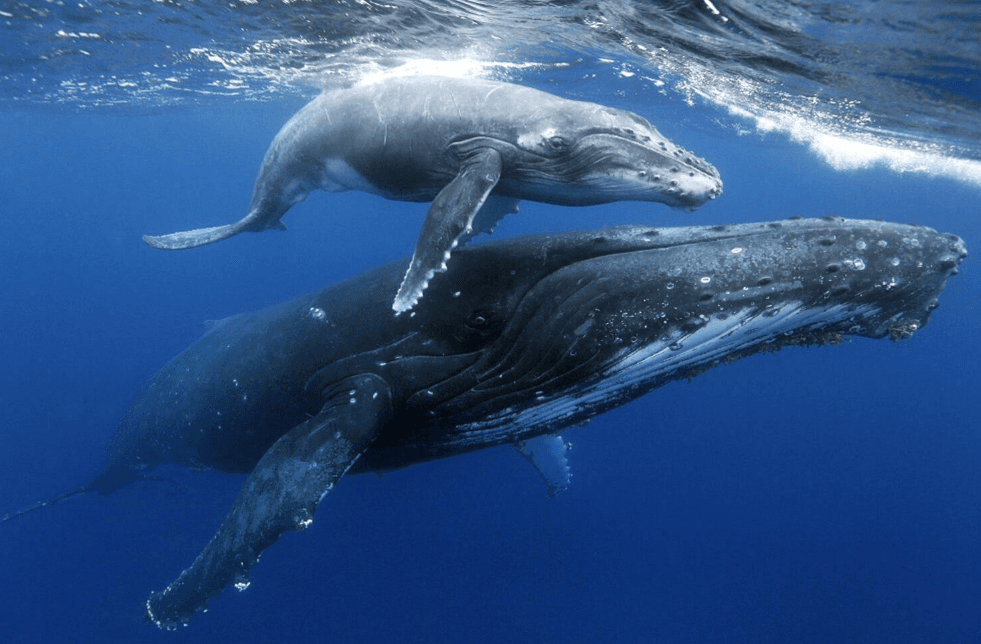
At birth, a calf is commonly around 4 to 5 meters (13 to 16 feet) long and may weigh approximately 1 to 2 metric tonnes. These are approximate ranges, not measurements that apply to every calf.
A newborn calf must grow considerably before reaching adult size. Its early development takes place in the ocean, where it relies on its mother for milk and protection.
The difference between a newborn calf and a fully grown adult illustrates just how much humpback whales develop throughout their lives.
How Much Do Humpback Whales Weigh?
An adult humpback whale can weigh approximately 25 to 40 metric tonnes, equivalent to about 25,000 to 40,000 kilograms.
In pounds, that is roughly 55,000 to 88,000 pounds.
These figures are useful estimates rather than strict limits. A whale's weight can vary with its length, body condition, nutritional status, and other biological factors.
Why are humpback whales so heavy?
Humpback whales have large bodies that support powerful muscles, internal organs, and the structures needed for swimming and diving.
Their bodies also contain substantial stores of fat, known as blubber. Blubber helps insulate the whale, stores energy, and supports essential body functions.
The combination of a large body and substantial blubber contributes to the whale's impressive weight.
Unlike animals that live primarily on land, whales are supported by the surrounding water. This buoyancy helps support their enormous bodies, although swimming still requires coordinated muscular effort.
Can a humpback whale weigh as much as several elephants?
Yes. A large humpback whale can weigh as much as several adult elephants combined, depending on the animals being compared.
However, exact comparisons depend on the size and species of elephant and the individual whale. Such comparisons are useful for visualization, but they should not be treated as precise scientific measurements.
The key point is that humpback whales are massive mammals whose weight is difficult to appreciate from a distance.
How Long Are a Humpback Whale's Flippers?
Humpback whales are famous for their exceptionally long pectoral fins, commonly called flippers.
These flippers can reach roughly one-third of the whale's body length. On a large individual, that can mean several meters from the base to the tip.
Their unusually long flippers help distinguish humpback whales from many other large whale species.
What do humpback whale flippers do?
The flippers play an important role in movement and maneuvering. They help the whale steer and control its position as it swims.
Humpback whales can move their flippers in different ways while swimming, and the broad surfaces help them interact with the surrounding water.
The flippers may also be visible during certain surface behaviors. A whale might raise a flipper above the water or slap it against the surface, although not every encounter includes these displays.
For visitors watching from a boat, a raised pectoral fin can provide a striking sense of scale. Even so, observers should avoid estimating the animal's total length from a single brief movement.
How Big Is a Humpback Whale's Tail?
A humpback whale's tail, known as its flukes, is broad and powerful.
The tail flukes help propel the whale through the water. When a humpback raises its tail above the surface before diving, observers may get a clear view of the distinctive shape and markings on the underside.
The width of the tail varies among individuals. It is therefore better to describe the flukes as broad and substantial than to assign one measurement to every humpback whale.
Why does the tail sometimes appear enormous?
Perspective can make a whale's tail seem particularly large when it rises above the water. The surrounding ocean offers few familiar objects for comparison, and the tail may be the only part of the animal visible.
The tail is also an important part of humpback whale identification. Researchers can compare photographs of the underside of the flukes because individuals often have distinctive patterns of pigmentation and scarring.
Those markings help researchers recognize individual whales across separate sightings. They do not, by themselves, reveal the animal's exact size or age.
How Do Humpback Whales Compare With Humans?
A humpback whale is much longer and heavier than a human.
An adult measuring 15 meters is about ten times the height of a person who is 1.5 meters tall. The comparison is only a simple length illustration; it does not mean the whale is ten times larger in every dimension.
A whale's body is also far wider and heavier than a human body. Its flippers and tail add to the animal's overall visual impact.
Because a whale is viewed in a moving marine environment, the full size may not be obvious during a short encounter. It may surface briefly, show its back, and disappear before visitors can see its entire body.
Photographs can help illustrate scale, but wide-angle lenses and camera distance may distort apparent proportions. A photograph is not necessarily a reliable way to estimate an individual whale's length.
How Do Humpback Whales Compare With Other Whales?
Humpback whales are large marine mammals, but they are not the largest whale species.
The blue whale is the largest known animal, reaching lengths and weights well beyond those typical of humpback whales. Fin whales can also grow longer than many humpbacks.
Other whale species differ substantially in their body proportions, feeding adaptations, and maximum size.
Humpback whales stand out not because they are the biggest of all whales, but because they combine a large body with unusually long pectoral fins and recognizable surface behaviors.
These physical characteristics make them a favorite subject for marine wildlife photography and whale-watching excursions.
Why Does Humpback Whale Size Matter?
Body size influences several aspects of a whale's life, including movement, energy needs, and the physical demands of living in the ocean.
A large animal requires sufficient energy to maintain its body and carry out essential activities. The surrounding environment must provide appropriate resources for the whale's needs.
Size also affects how researchers study whales. Measuring a wild animal accurately can be difficult, particularly when it is swimming freely and cannot be examined closely.
Scientists use suitable measurement techniques and observational records to study growth, body condition, and differences between populations.
For visitors, understanding whale size offers a useful introduction to marine biology. It can also help put a brief encounter into perspective: the whale appearing beside a boat is a large, powerful wild animal, not a predictable attraction.
Can You See the Full Size of a Humpback Whale in Samaná Bay?
Sometimes, but not always.
Samaná Bay in the Dominican Republic is well known for seasonal visits by North Atlantic humpback whales. During the breeding season, visitors may see whales surfacing, swimming, diving, or displaying other natural behaviors.
Whether you can appreciate a whale's full length depends on the encounter. A whale might expose much of its back at the surface, or it might show only a small portion of its body before diving.
Water conditions, viewing distance, the whale's movement, and the boat's position all affect what passengers can see.
What might you see during a whale-watching trip?
Depending on the encounter, visitors may observe:
- A whale surfacing to breathe.
- The curve of its back moving through the water.
- A tail fluke rising before a dive.
- A long pectoral fin appearing above the surface.
- A calf swimming near its mother.
Not every trip includes all these sights, and no specific behavior or close encounter is guaranteed.
A responsible operator should follow applicable wildlife-viewing rules and prioritize passenger safety. Boats should not crowd, chase, or deliberately disturb whales to produce a better view.
How can you appreciate whale size safely?
Bring binoculars if they are permitted and useful for your trip, listen to the guide's instructions, and observe from the designated viewing position.
Avoid leaning over the boat or moving into unsafe positions to take photographs. A whale can change direction or surface unexpectedly, so maintaining a safe distance and following the crew's guidance are essential.
You do not need to get close to appreciate the scale of these animals. Even a brief sighting can reveal the enormous size of a humpback whale.
Frequently Asked Questions
How big is the biggest humpback whale?
Humpback whales vary in size, and maximum measurements differ among sources and populations. Adults commonly measure around 12 to 16 meters, while some individuals may be larger. Claims about record-sized whales should be checked against reliable measurement records.
Are female humpback whales bigger than males?
Generally, yes. Female humpback whales tend to be larger than males, although individual size varies.
How big is a baby humpback whale?
A newborn calf is commonly around 4 to 5 meters long and may weigh approximately 1 to 2 metric tonnes. These figures are approximate.
How much does a humpback whale weigh in pounds?
An adult humpback whale may weigh approximately 55,000 to 88,000 pounds, based on an estimated weight of 25 to 40 metric tonnes.
Are humpback whales bigger than dolphins?
Humpback whales are substantially larger than most dolphin species in both length and weight. Dolphins vary in size, but even large dolphin species are generally much smaller than adult humpback whales.
Are humpback whales the largest animals in the ocean?
No. Blue whales are the largest known animals. Humpback whales are impressive in size but are smaller than blue whales.
Can I estimate a whale's size while whale watching?
You can get a general impression of its scale, but accurately measuring a wild whale from a boat is difficult. Visual estimates should not be treated as precise measurements.
Final Thoughts: Appreciating the Size of Humpback Whales
Humpback whales are enormous marine mammals, with adults commonly measuring around 12 to 16 meters long and weighing approximately 25 to 40 metric tonnes. Their long pectoral fins and broad tail flukes make them especially recognizable.
Their size is more than a fascinating fact. It reflects the remarkable physical adaptations that allow these animals to live and move through the ocean.
For visitors to Samaná Bay, seeing a humpback whale in the wild can make these measurements feel much more meaningful. Whether you glimpse its back, flipper, or tail, the encounter offers a reminder of the extraordinary wildlife found in Dominican Republic waters.
Observe from a safe distance, follow your guide's instructions, and appreciate these magnificent animals without disturbing their natural behavior.

Local explorer & expert guide in Whales of Samaná.