Do Humpback Whales Shed Their Skin Understanding Whale Skin Renewal
Humpback whales spend their lives moving through saltwater, from feeding grounds in cooler oceans to warmer breeding areas such as Samaná Bay in the Dominican Republic. Their skin is constantly exposed to seawater, sunlight near the surface, microorganisms, and contact with other marine organisms.
But do humpback whales shed their skin like snakes do?
Yes, humpback whales continually renew their outer skin cells. However, they do not normally shed their entire outer covering in one piece. Instead, old surface cells are gradually replaced as new cells develop beneath them.
This natural process helps maintain the whale’s skin, while visible scars, pigmentation patterns, and marks from marine organisms can provide clues about an individual whale’s life.
Do Humpback Whales Shed Their Skin?
Humpback whales have skin that undergoes continuous renewal. Like other mammals, they produce new skin cells as older cells reach the surface and are eventually lost.
This process is called skin turnover or desquamation. It happens gradually rather than through a dramatic, whole-body shedding event.
The outer skin layer acts as a protective barrier between the whale’s body and the marine environment. Beneath it are deeper layers containing structures that support skin growth, repair, and normal function.
Although skin renewal is a normal biological process, the exact rate can vary with factors such as age, body condition, and environmental circumstances. There is no single established shedding schedule that applies to every humpback whale.
What Is Humpback Whale Skin Made Of?
Humpback whale skin is made of several layers, each with a different role.
The epidermis
The epidermis is the outermost layer. It contains cells that gradually mature and move toward the surface, where they are eventually shed.
This layer helps protect the whale from its surroundings and contributes to the distinctive appearance of its skin.
The dermis
The dermis lies beneath the epidermis. It contains connective tissue, blood vessels, nerves, and structures that support the skin.
The dermis helps provide strength and flexibility, allowing the skin to function as part of the whale’s large body.
The blubber beneath the skin
Under the skin is a thick layer of blubber, made primarily of fat and associated connective tissue. Blubber helps insulate the whale, stores energy, and contributes to its body shape.
Blubber is not the same as skin. Skin renewal occurs in the outer covering, while blubber performs different functions deeper within the body.
Why Do Humpback Whales Need to Renew Their Skin?
Skin renewal is a normal part of maintaining healthy tissue. As older cells are lost, new cells help replace them.
Several functions make healthy skin important for humpback whales.
Protection: The skin forms a barrier against the surrounding environment and helps protect deeper tissues.
Tissue maintenance: Continuous cell replacement supports the normal condition of the outer skin.
Surface integrity: The skin must remain flexible as the whale swims, turns, dives, and surfaces.
Recovery from minor damage: Skin tissue can repair certain forms of damage, although healing depends on the nature and severity of an injury.
Skin renewal does not make whales immune to injury, infection, parasites, or environmental threats. Serious wounds can leave permanent scars or require extended healing.
Why Does Humpback Whale Skin Sometimes Look White, Gray, or Patchy?
Humpback whales have distinctive coloration, often combining dark upper surfaces with lighter markings on the underside. Their pigmentation varies between individuals, particularly around the belly and tail flukes.
These patterns are not necessarily signs of skin shedding.
Several factors contribute to the appearance of a whale’s skin:
- Natural pigmentation: Different areas of the body have different colors and patterns.
- Scars: Previous injuries can leave long-lasting marks.
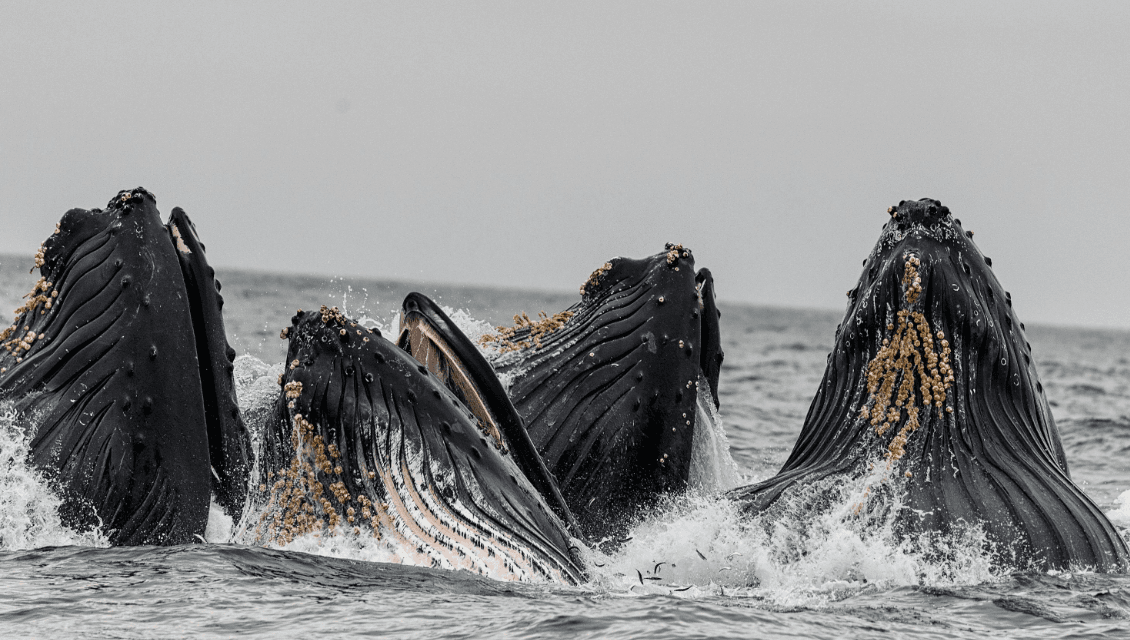
- Marine organisms: Barnacles, whale lice, and other organisms may be visible on some parts of the body.
- Lighting and water conditions: Reflections, shadows, and the angle of observation can change how skin appears in photographs.
- Surface changes: Normal skin renewal and minor abrasion may affect the outer surface without producing a dramatic visible change.
Researchers use photographs of distinctive markings, especially tail-fluke patterns, to help identify individual humpback whales. These patterns can remain useful over multiple seasons, although injuries and other changes may alter a whale’s appearance.
Do Humpback Whales Have Parasites on Their Skin?
Humpback whales can carry marine organisms on their bodies. Some are associated with the whale’s skin, while others attach to particular areas or live in close association with the animal.
Examples include whale lice, which are small crustaceans, and barnacles that can attach to whale skin. The types and amounts of these organisms vary among individuals and locations.
Their presence does not automatically mean a whale is sick. Some associations are common in wild whales, and their biological effects depend on the organism and circumstances.
Skin renewal may influence the surface habitat available to organisms living on or near the skin, but it should not be described as a guaranteed way for whales to remove every parasite or barnacle.
Researchers study skin condition and associated organisms to learn more about whale health, ecology, and interactions with the marine environment.
Can You See Humpback Whale Skin Shedding in Samaná Bay?
Samaná Bay is a well-known seasonal destination for North Atlantic humpback whales. During the winter breeding season, visitors may see whales surfacing, raising their tails, or swimming near the surface.
However, normal skin renewal is generally too subtle to identify during a typical whale-watching trip.
Visitors may notice contrasting skin colors, pale markings, scars, or organisms attached to a whale. These features can be interesting to observe, but they do not necessarily indicate active shedding.
A responsible whale-watching guide can help explain visible features without claiming to diagnose a whale’s health from a brief sighting.
Whales should be observed from a suitable distance, following local regulations. Boats should never approach or disturb an animal simply to obtain a closer look at its skin.
What Can Scientists Learn From Humpback Whale Skin?
Skin can provide valuable information for marine research. Scientists use several methods to study whales while minimizing disturbance.
Photo identification
Photographs of tail flukes, dorsal fins, and other distinctive features help researchers recognize individual whales. Long-term identification records can reveal movements, site use, and patterns of return to particular regions.
Skin sampling
In some research projects, scientists collect small skin samples using approved methods. These samples can support genetic research and help investigate relationships between individuals or populations.
Skin samples may also be examined for certain biological indicators, depending on the research question and the sampling method.
Health monitoring
Researchers can document visible injuries, unusual skin conditions, and changes in appearance. Such observations can contribute to broader assessments of whale health, although external appearance alone cannot establish a complete diagnosis.
Environmental research
Skin and associated biological samples may help researchers investigate exposure to environmental contaminants or other factors. Interpretation requires careful scientific methods and appropriate comparison data.
Research involving whales must follow applicable permits, animal-welfare requirements, and conservation guidelines.
Can Pollution Affect Humpback Whale Skin?
Marine pollution can affect whales in different ways, depending on the pollutant, exposure level, and route of exposure. Some pollutants may accumulate in body tissues or influence biological processes, while entanglement and other human activities can cause physical injuries.
It would be inaccurate to assume that every skin mark or patch on a humpback whale is caused by pollution. Natural pigmentation, past injuries, and marine organisms can also explain visible differences.
Protecting ocean habitats, reducing plastic pollution, managing chemical contaminants, and preventing harmful interactions with fishing gear are important conservation goals.
Healthy marine ecosystems benefit whales and the many other species that depend on the ocean.
How Is Whale Skin Different From Human Skin?
Humpback whales and humans are both mammals, so their skin shares some basic biological features, including an epidermis and a deeper dermis.
However, whale skin is adapted to a very different environment.
FeatureHumpback whaleHumanMain environmentAquaticPrimarily terrestrialSkin renewalContinuous cell replacementContinuous cell replacementInsulationThick blubber beneath the skinMainly depends on other tissues, clothing, and body responsesVisible patternsPigmentation, scars, and markings used in researchPigmentation and scars can also varyResearch applicationsIdentification, genetics, and health studiesIdentification, medical, and biological research
Both species continually renew their outer skin cells, but their skin and underlying tissues have evolved to meet different environmental demands.
Frequently Asked Questions
Do humpback whales shed their skin in one piece?
No. Humpback whales generally renew their outer skin gradually as old cells are replaced and shed. They do not normally peel off their entire skin in one piece.
How often do humpback whales shed their skin?
Their skin undergoes ongoing renewal, but a precise, universally applicable shedding interval is not established for every individual.
Does white skin mean a humpback whale is shedding?
Not necessarily. White or pale areas can be part of natural pigmentation or may reflect scars, lighting, or other surface features.
Can whale skin grow back after an injury?
Whale skin can repair some injuries, but healing depends on the type and severity of the damage. Some injuries leave permanent scars.
Can researchers identify humpback whales from their skin?
Researchers can use visible markings and photographs to identify individuals. Tail-fluke patterns are especially useful, while skin samples can provide additional genetic information in approved studies.
Can tourists see skin renewal during whale watching in Samaná?
Usually not. Skin renewal is gradual and generally cannot be distinguished during an ordinary surface sighting.
Final Thoughts
Humpback whales continually renew their skin, just as other mammals do. This process helps maintain their protective outer covering, while pigmentation, scars, and associated marine organisms contribute to the appearance of individual whales.
Although skin shedding itself is rarely visible during whale watching, learning about whale skin helps visitors understand the biology behind the animals they encounter in Samaná Bay.
By observing whales responsibly and supporting marine conservation, visitors can appreciate these remarkable mammals without interfering with their natural behavior.

Local explorer & expert guide in Whales of Samaná.