How Humpback Whales Communicate in Samaná Bay
Every year, humpback whales arrive in the warm waters around Samaná Bay in the Dominican Republic. Their impressive breaches and powerful tail movements attract attention, but some of their most fascinating behaviors happen beneath the ocean's surface.
Humpback whales communicate using a combination of sounds, songs, and physical movements. These behaviors help scientists understand how whales interact, reproduce, and respond to their surroundings.
If you're interested in the science behind whale watching, learning how these marine mammals communicate adds another dimension to understanding their seasonal presence in Samaná.
How Do Humpback Whales Communicate?
Humpback whales use sound as an important way to communicate underwater. They also produce visible movements that may serve different functions depending on the situation.
Their communication methods include:
- Songs: Complex patterns of sounds commonly associated with male humpback whales.
- Social sounds: Individual calls and other vocalizations that may help whales interact.
- Body movements: Breaching, tail slapping, and fin movements that may communicate information or serve other behavioral purposes.
Scientists continue to investigate exactly what different sounds and movements mean. Although researchers have identified patterns in whale behavior, it is important not to assume that every movement has one specific meaning.
1. The Mysterious Songs of Humpback Whales
Humpback whale songs are among the most recognizable sounds in the marine world. They can contain repeated sequences of moans, groans, squeaks, and other acoustic patterns.
These sounds can form elaborate sequences that continue for extended periods. Unlike random noises, whale songs often contain organized patterns that researchers can study and compare.
Male humpback whales are especially known for producing these elaborate songs during the breeding season. Scientists believe the songs play a role in reproduction, although their complete purpose remains a subject of research.
Do All Humpback Whales Sing the Same Song?
Not necessarily. Humpback whale songs can vary between populations and change over time.
Whales within the same population may share similar song patterns. Researchers have also documented changes in songs as they spread between groups in different regions.
This makes whale songs useful for studying animal communication, social learning, and the behavior of migrating whale populations.
Can Visitors Hear Whale Songs in Samaná Bay?
Most standard whale-watching excursions take place aboard boats without specialized underwater listening equipment. As a result, visitors should not expect to hear whale songs during an ordinary trip.
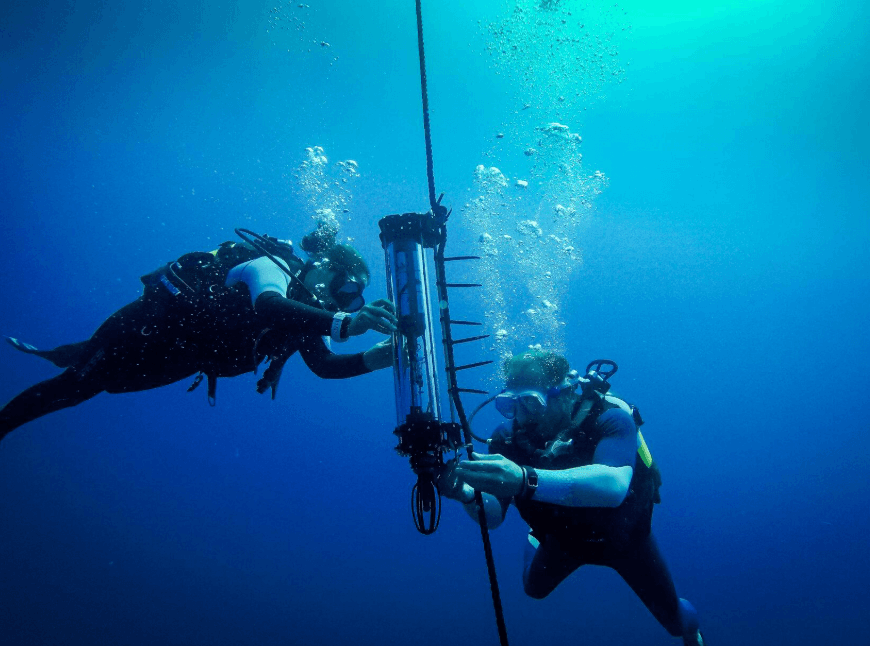
Whale sounds travel underwater, but hearing them from a boat above the surface is different from listening through a hydrophone, an underwater microphone designed to record aquatic sounds.
If hearing whale vocalizations is your main interest, look for educational recordings or scientific presentations that use verified humpback whale audio.
2. How Whales Use Sound Underwater
Sound travels efficiently through water, making it important for many marine animals.
Humpback whales produce vocalizations in an underwater environment where visibility may be limited. Sounds can provide information that is difficult to obtain through sight alone.
Researchers study whale vocalizations to investigate several questions:
- How do whales interact when they are separated?
- Do particular sounds occur more often during specific activities?
- How do whales change their vocal behavior in different environments?
- Can researchers identify recurring acoustic patterns among different whale groups?
There is no single sound that scientists can confidently interpret as having the same meaning in every situation. The meaning of a vocalization may depend on the animal, its behavior, and the surrounding circumstances.
3. Breaching: Communication or Another Purpose?
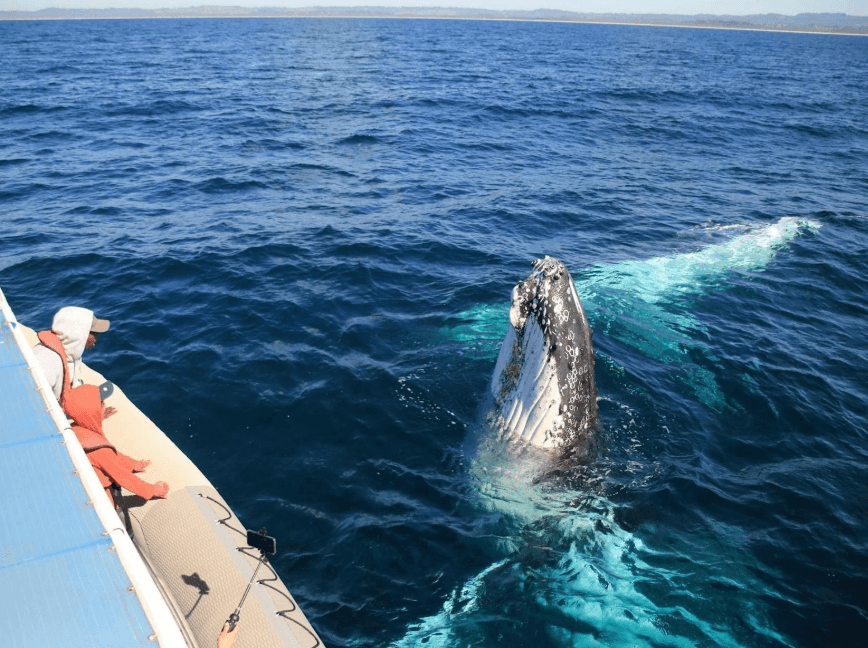
One of the most dramatic sights in Samaná Bay is a humpback whale launching much of its body out of the water before landing with a splash.
This behavior is known as breaching.
Breaching may have several possible functions, including communication, social interaction, parasite removal, or other behavioral purposes. Scientists do not assume that every breach serves the same function.
The impact creates a large splash and may produce sound that travels through the water. Researchers continue to investigate how such displays relate to whale behavior and interactions.
For visitors, a breach offers a remarkable opportunity to observe a whale's strength and agility. However, a breach alone does not reveal exactly what the animal is trying to communicate.
4. Tail Slapping and Pectoral Fin Movements
Humpback whales also perform visible movements that can be striking to observe.
Tail Slapping
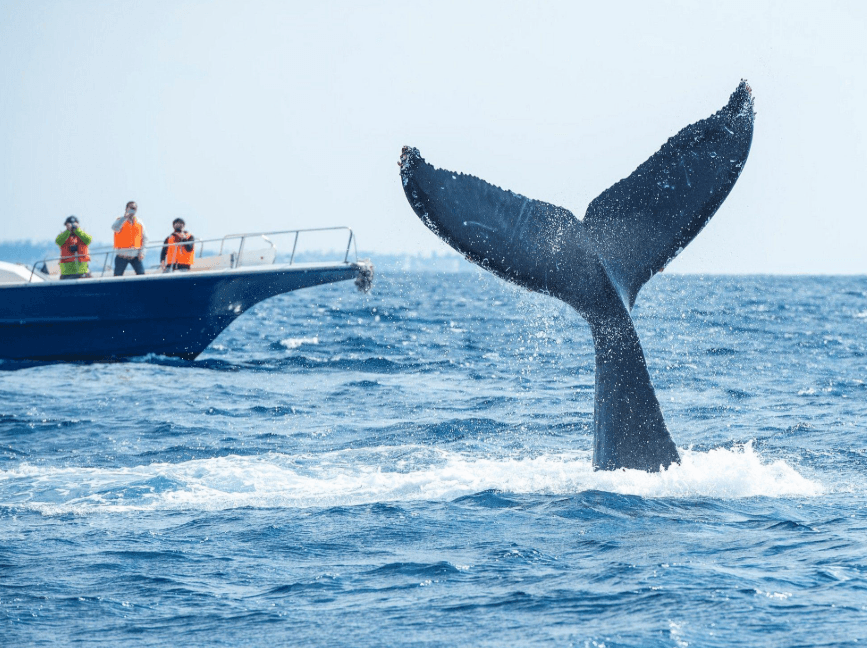
Tail slapping occurs when a whale raises its tail flukes and strikes the water. The resulting splash can be substantial, and the impact may generate sound.
Depending on the circumstances, tail movements may be associated with social interactions or other behaviors. It is not possible to determine the exact meaning of every tail slap from a brief observation.
Pectoral Fin Slapping
Humpback whales have exceptionally long pectoral fins. A whale may raise one fin and slap it against the surface.
This behavior can create a visible splash and may occur during social activity. Researchers consider the surrounding context when studying what these movements might indicate.
Why Context Matters
A whale that breaches, slaps its tail, or raises a fin is displaying a behavior that can be observed. Understanding why it performs that behavior requires more information.
Scientists examine factors such as the whale's position, nearby animals, repeated movements, and the sequence of events before and after the display.
This is one reason responsible whale-watching observations are valuable when conducted without disturbing the animals.
5. How Mother Whales and Calves Interact
Samaná Bay is associated with the seasonal presence of humpback whales, including mothers and their calves.
A calf must develop the skills needed to survive in the marine environment. Close association with its mother is an important part of early development.
Mother-and-calf pairs may remain close together while swimming and surfacing. Researchers can study their movements and acoustic behavior to better understand how they interact.
However, observers should be careful about interpreting these encounters. A mother swimming near her calf does not necessarily indicate a particular emotional state, and a calf's movement should not automatically be described as an attempt to communicate a specific message.
Scientists use systematic observations and acoustic research to investigate these relationships more reliably.
6. Can Whale Songs Be Understood Like Human Language?
Humpback whale songs are complex, but that does not mean researchers can translate them into human sentences.
Scientists can identify repeating acoustic patterns, compare songs, and investigate when particular vocalizations occur. These findings help reveal aspects of whale communication.
However, the exact information carried by many sounds remains uncertain.
It is more accurate to describe humpback whale songs as complex vocal behavior than to claim that researchers know precisely what every sound means.
This distinction is important because it separates documented scientific findings from speculation about animal communication.
7. Why Samaná Bay Is Interesting for Whale Communication Research
Samaná Bay is part of the Dominican Republic's wider marine environment associated with the seasonal migration of North Atlantic humpback whales.
The whales' presence during the breeding season provides opportunities for researchers to observe their behavior in a tropical marine setting.
Scientists studying humpback whales in different locations can compare vocalizations, social behavior, and patterns of movement. Such comparisons help improve understanding of whale populations and their behavior across their migratory range.
Samaná is also a place where visitors can learn about marine wildlife. A whale-watching trip cannot replace scientific research, but careful observation can encourage a deeper appreciation of the animals.
The most useful observations focus on what can actually be seen, without assuming that every display reveals the whale's intentions.
8. How to Observe Whale Behavior Responsibly
If you join a whale-watching excursion in Samaná, you may see behaviors such as surfacing, breaching, tail slapping, or swimming alongside another whale.
You can make the experience more informative by observing details rather than trying to assign a definite meaning to every movement.
Consider these tips:
- Watch the sequence: Notice what happens before and after a movement.
- Look for group behavior: Observe whether other whales are nearby.
- Listen to knowledgeable guides: Ask what scientists know about the behavior and what remains uncertain.
- Avoid disturbing the animals: Follow the crew's instructions and applicable wildlife-viewing regulations.
- Be patient: Whales may remain underwater for periods of time, and not every trip includes dramatic surface displays.
A respectful distance is important, especially when mothers and calves are present. The crew should follow applicable whale-watching rules rather than approaching animals to provoke a reaction.
Frequently Asked Questions
Do humpback whales sing in Samaná Bay?
Humpback whales are known for producing songs during the breeding season. They may vocalize while in their seasonal breeding habitat, but visitors should not assume that songs will be audible from a whale-watching boat.
Why do humpback whales make sounds?
Their vocalizations are associated with communication and social behavior. Researchers continue to investigate the precise functions of different sounds and how these functions may vary with context.
Do humpback whales communicate by breaching?
Breaching may have a communicative or social function, among other possible purposes. A breach does not always mean the whale is sending a specific message.
Can visitors record whale songs during a tour?
Ordinary cameras and phones generally cannot record underwater whale sounds clearly from above the surface. Specialized underwater microphones are used to capture vocalizations.
Are whale songs the same every year?
No. Researchers have documented changes in humpback whale songs over time, including changes in the patterns shared by whales within a population.
Is Samaná Bay a good place to learn about humpback whales?
Samaná is a well-known seasonal destination for observing North Atlantic humpback whales. Visitors can learn about whale behavior through responsible excursions and educational resources, although sightings and the behaviors observed vary.
Final Thoughts
Humpback whales communicate through a fascinating combination of songs, vocalizations, and physical movements. Their behavior offers researchers valuable clues about social interaction, reproduction, and life in the ocean.
In Samaná Bay, learning about these behaviors can make whale watching more meaningful. A breach becomes more than a dramatic splash, and a tail movement becomes an opportunity to observe rather than speculate.
The more we learn about humpback whales, the clearer it becomes that their underwater world is complex and still holds many unanswered questions. Respectful observation and continued scientific research are essential to understanding these remarkable marine mammals.

Local explorer & expert guide in Whales of Samaná.