Why Do Humpback Whales Have Two Blowholes?
Humpback whales have several remarkable adaptations that help them live in the ocean, and their blowholes are among the most important. Unlike humans, who breathe through their noses and mouths, humpback whales breathe through openings located on top of their heads.
One interesting detail is that humpback whales have two blowholes rather than one. These paired openings are part of their anatomy as baleen whales and help them exchange air when they surface.
During a whale-watching trip in Samaná Bay, Dominican Republic, visitors may notice a whale rising to the surface and releasing a visible blow. Although the breathing process can happen quickly, understanding the anatomy behind it makes the sighting even more fascinating.
In this guide, you will learn why humpback whales have two blowholes, how these openings work, and how to recognize their role during a Samaná whale-watching excursion.
What Are Humpback Whale Blowholes?
Blowholes are the external openings of a whale's respiratory system. In humpback whales, they are located on top of the head, allowing the animal to breathe while exposing only a small portion of its body above the water.
Humpback whales belong to a group known as baleen whales, which includes other large species such as blue whales and fin whales. Baleen whales have two blowholes, while toothed whales, such as dolphins and sperm whales, generally have one.
The position of the blowholes is an important adaptation to life in the ocean. It allows a humpback whale to surface, exchange air, and return underwater without lifting its entire body out of the water.
Why Do Humpback Whales Have Two Blowholes?
The two blowholes are paired respiratory openings inherited through the evolutionary history of baleen whales. They are part of the anatomy that enables these animals to breathe air efficiently while living in an aquatic environment.
Their paired structure distinguishes baleen whales from toothed whales, which have a single blowhole.
It is important to understand that having two blowholes does not mean a humpback whale breathes twice as fast or has twice the lung capacity of an animal with one blowhole. The number of openings is an anatomical feature, not a simple measurement of breathing ability.
An Evolutionary Adaptation
Whales evolved from land-dwelling ancestors. Over millions of years, their bodies became increasingly adapted to life in water, including changes to the position of their nostrils.
In modern whales, the nostrils are positioned toward the top of the head, where they function as blowholes. This arrangement makes breathing at the surface more practical.
Baleen whales retained paired blowholes, while toothed whales evolved a single external blowhole. These differences reflect distinct evolutionary paths within the whale family.
How Are Two Blowholes Different From One?
The main difference is anatomical: humpback whales have two external respiratory openings, whereas toothed whales generally have one.
Both types of whales must surface to breathe air. The number of blowholes does not mean one group can breathe underwater while the other cannot.
For humpback whales, the paired openings are part of a respiratory system adapted to their size, physiology, and way of life.
How Do Two Blowholes Work?
When a humpback whale surfaces, it clears its blowholes of water and exchanges air through its respiratory system. The openings are controlled by specialized muscles that help close them when the whale dives.
The breathing sequence generally includes the following stages:
- Surfacing: The whale rises until its blowholes can clear the water.
- Exhaling: Air is released through the blowholes, often producing a visible plume.
- Inhaling: The whale takes in fresh air.
- Closing the openings: The blowholes close as the whale returns underwater.
The process is brief, and observers may see only the visible exhalation before the animal submerges.
Although humpback whales have two blowholes, their breathing should be understood as one coordinated respiratory process rather than two separate breathing systems.
Why Are the Blowholes on Top of the Head?
The location of the blowholes helps humpback whales breathe without exposing much of their bodies.
When a whale approaches the surface, it can bring the top of its head above the water, take a breath, and continue swimming or diving.
This adaptation is especially useful for an animal that spends much of its time submerged. It allows the whale to exchange air while minimizing the need to lift its body out of the ocean.
During whale watching in Samaná Bay, you may see the whale's back appear before its blow becomes visible. The exact sequence depends on its position, direction, and movement.
Why Does a Humpback Whale's Blow Look Like a Spray?
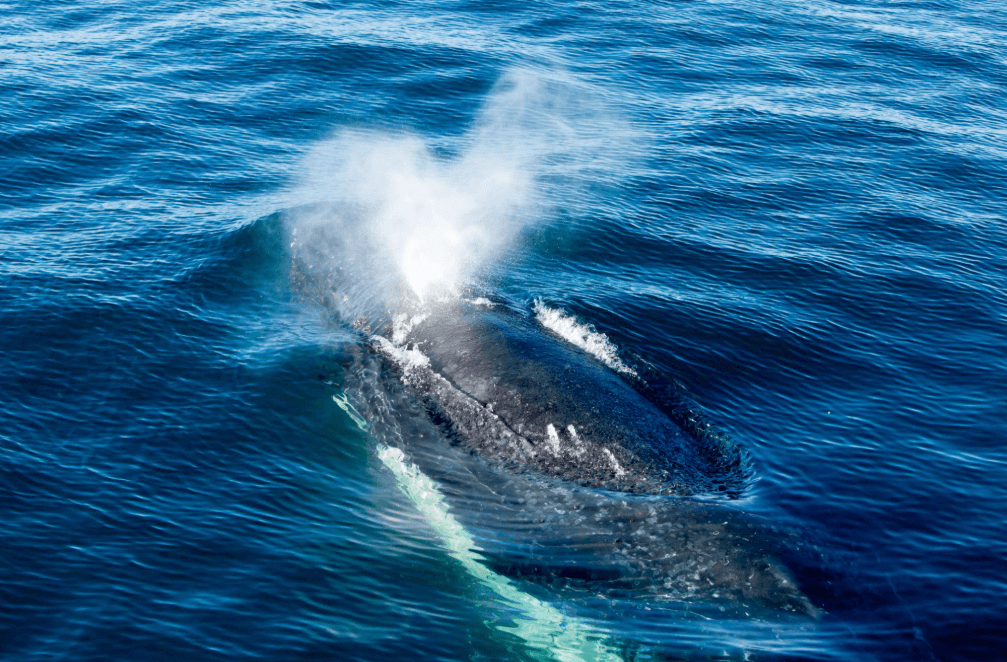
When a humpback whale exhales, the visible blow consists mainly of expelled air and moisture, including droplets and condensed water vapor. Its appearance can vary depending on environmental conditions.
The plume may look tall or broad, or it may be difficult to see in strong wind. Sunlight, viewing distance, and the angle of observation can also affect how clearly it appears.
The visible blow is not simply seawater being pumped out of the whale's lungs. It is associated with exhalation and moisture around the breathing openings.
For whale watchers, the blow can be a useful clue that a whale has surfaced, but its appearance alone cannot reliably establish the animal's identity or health.
Can You See Both Blowholes During a Samaná Whale-Watching Tour?
Usually, visitors watch from a distance and may not have a clear view of the two individual openings. The whale's head may be visible only briefly, and the surrounding water can obscure small anatomical details.
You are more likely to notice the overall surfacing sequence and the blow than to distinguish each blowhole separately.
If your guide explains the anatomy during the encounter, use the opportunity to learn about the whale's respiratory system. Binoculars may help with observation when conditions permit, but passengers should always remain in safe viewing positions.
Do not encourage a boat to approach more closely simply to get a detailed photograph of the whale's head.
Do Baby Humpback Whales Have Two Blowholes?
Yes. Humpback whale calves have two blowholes, just like adult humpback whales.
Calves must breathe air from the beginning of their lives. They surface to breathe while developing the swimming skills needed to move through their marine environment.
During the Samaná breeding season, visitors may have the opportunity to see mothers and calves. However, sightings are not guaranteed, and boats must follow appropriate wildlife-viewing rules to avoid disturbing them.
The paired blowholes are a normal part of humpback whale anatomy throughout life.
Humpback Whale Blowholes Compared With Other Marine Mammals
Different marine mammals have respiratory openings adapted to their evolutionary history.
- Humpback whales: Have two blowholes.
- Blue whales: Also have two blowholes because they are baleen whales.
- Sperm whales: Have one blowhole, positioned asymmetrically on the head.
- Dolphins: Generally have one blowhole.
All these animals breathe air. Their differences in blowhole structure do not change the fundamental fact that they must surface to breathe.
What Can You Learn From Blowholes While Whale Watching?
Observing a whale's breathing can help you understand its anatomy and behavior.
During a Samaná whale-watching trip, look for the following:
- The surfacing movement: Notice how the whale brings its head toward the surface.
- The visible blow: Watch for the plume associated with exhalation.
- The timing of the dive: Observe how the whale returns underwater after breathing.
- The surrounding conditions: Wind and waves can change how clearly you see the blow.
- The guide's explanation: Learn how the respiratory system differs among whale species.
Remember that a single surface appearance does not reveal everything about the whale's activity. Focus on what you can actually observe and treat explanations of hidden behavior with appropriate caution.
Responsible Whale Watching in Samaná Bay
Humpback whales visit Samaná's waters seasonally, making the area an important destination for whale watching in the Dominican Republic.
Responsible viewing means giving whales enough space to move, surface, and breathe naturally. Choose an operator that follows applicable regulations and explains safe wildlife-viewing practices.
Remain in designated areas, follow crew instructions, and keep cameras and phones secure. Never ask a boat operator to chase a whale or interrupt its movement for a close-up photograph.
The best encounters allow visitors to observe the animals without interfering with their natural activities.
Frequently Asked Questions
1. Why do humpback whales have two blowholes?
Humpback whales are baleen whales, a group characterized by two blowholes. These paired openings are part of their evolutionary anatomy and respiratory system.
2. Do humpback whales use both blowholes to breathe?
The two openings form part of one coordinated respiratory system. Their presence does not mean the whale has two independent breathing systems.
3. Do humpback whales breathe through their mouths?
No. They breathe through their blowholes, which are located on top of the head.
4. Can water enter a humpback whale's blowholes?
Specialized muscles help close the blowholes when the whale dives, helping prevent water from entering the respiratory tract.
5. Do all whales have two blowholes?
No. Baleen whales, including humpback whales, have two. Toothed whales generally have one.
6. Do baby humpback whales have blowholes?
Yes. Calves have two blowholes and must surface to breathe air from the beginning of their lives.
7. Can I see a humpback whale's blowholes in Samaná Bay?
You may see the whale's head as it surfaces, but individual openings can be difficult to distinguish from a tour boat. The visible blow is often easier to notice.
Final Thoughts
Humpback whales have two blowholes because they belong to the baleen whale group, whose paired respiratory openings reflect their evolutionary history. Located on top of the head, these openings allow the whales to exchange air at the surface before returning underwater.
The next time you see a humpback whale surface in Samaná Bay, look for its blow and consider the anatomy that makes this brief moment possible. Even a simple breath can reveal something remarkable about how whales are adapted to life in the ocean.
By observing patiently and respecting wildlife-viewing guidelines, you can make your Samaná whale-watching experience both memorable and educational.

Local explorer & expert guide in Whales of Samaná.