Why Humpback Whales Gather in Groups in Samaná Bay
Seeing one humpback whale rise through the ocean is an unforgettable experience. Seeing several whales surfacing near one another can make a whale-watching trip in Samaná Bay even more fascinating.
Humpback whales are not always solitary animals. Depending on the season and circumstances, they may be seen in mother-calf pairs, groups of adults, or temporary gatherings involving several individuals. These associations can be connected to breeding activity, social interactions, and other aspects of their lives.
However, not every group has the same purpose. Some associations are closely related to calf care, while others may form temporarily and change as the whales move through the water.
Understanding why humpback whales gather in groups helps visitors interpret what they see during whale watching in the Dominican Republic.
Are Humpback Whales Social Animals?
Humpback whales show a variety of social behaviors. Although individuals may travel alone, they can also interact with other whales during important parts of their lives.
Unlike some marine mammals that live in stable, long-lasting social groups, humpback whales often form temporary associations. The size and composition of these groups can change over time.
A whale observed alongside another individual today may not remain with that whale for an extended period. Some encounters are brief, while others involve repeated interactions.
These changing relationships make humpback whale social behavior particularly interesting to researchers. Scientists study how individuals approach one another, coordinate their movements, vocalize, and respond to other whales.
For visitors in Samaná Bay, this means that the behavior of a group can be just as interesting as the number of whales present.
Why Do Humpback Whales Gather During Breeding Season?
One important reason humpback whales gather in certain areas is reproduction.
During the breeding season, males may approach females and interact with other males. Some groups involve several individuals moving together, and their composition can change as the interaction develops.
Male humpback whales may display competitive behavior when pursuing access to a female. Researchers often describe groups of whales involved in these interactions as competitive groups.
Such gatherings can include vigorous swimming, changes in direction, surface activity, and close interactions between individuals.
However, not every group of whales is competing for a mate. Some may be passing through the same area or engaging in other social behaviors.
Samaná Bay is an important seasonal breeding area for North Atlantic humpback whales, making it a place where visitors may encounter different forms of whale social activity.
The Special Bond Between Mother and Calf
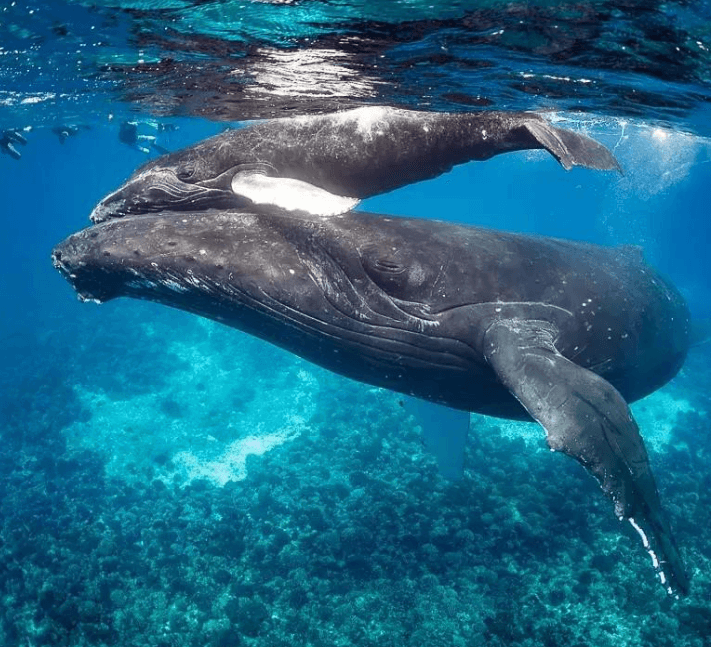
One of the clearest examples of a meaningful association between humpback whales is the relationship between a mother and her calf.
After birth, a calf depends on its mother for milk, protection, and support during its early development. The pair usually maintains close contact as they move through the water.
The mother provides nourishment through rich milk that supports the calf's rapid growth. Staying close also allows the calf to follow the mother's movements and remain near an important source of care.
Mother-calf pairs are especially relevant to whale watching because visitors may observe two whales traveling together, surfacing near one another, or moving at a similar pace.
Their close association does not mean that every pair will behave identically. Individual circumstances and environmental conditions influence their movements.
When a mother and calf are spotted during a tour, responsible viewing practices are particularly important. Boats should not separate the pair, block their path, or approach them too closely.
Why Do Several Whales Sometimes Swim Together?
When several humpback whales appear together, their association may reflect a temporary social interaction rather than a permanent group structure.
The whales may approach one another, swim in similar directions, or change positions as the encounter develops. Some group formations are connected to breeding activity, while others may be less clearly understood.
Scientists examine details such as group composition, movement, duration, and the behavior of individual whales to interpret these encounters.
Simply seeing several whales together does not reveal exactly why they gathered. Their behavior must be considered in context.
For example, a group that includes a female and several males may be involved in a competitive interaction. A pair consisting of an adult and a smaller whale may be a mother and calf, although size alone is not enough to confirm their relationship.
The most accurate interpretation comes from careful observation rather than assuming every gathering has the same explanation.
How Do Humpback Whales Interact With One Another?
Humpback whales use several forms of behavior during social encounters.
Swimming near one another
Whales may travel close together, alter their spacing, or move in similar directions. These movements can help researchers document how individuals interact during an encounter.
Surface activity
Breaching, tail slapping, and other surface behaviors may occur during social interactions. However, these actions have multiple possible functions, and observers cannot reliably assign one meaning to every display.
Vocalizations
Humpback whales produce a variety of sounds, including the complex sequences commonly called songs. Researchers have also documented other vocalizations associated with different contexts.
Sound is an important part of humpback whale behavior, but a vocalization heard during a group encounter does not automatically reveal the exact purpose of the interaction.
Changes in group formation
A group may become larger, smaller, or reorganized as individual whales approach or leave. These changes can happen relatively quickly.
Together, these behaviors help researchers investigate the social lives of humpback whales.
Do Humpback Whales Form Friendships?
It is tempting to describe two whales that repeatedly travel together as friends. However, scientific interpretation requires care.
Researchers can study repeated associations and determine whether particular individuals are seen together more often than expected. These observations may provide evidence about social relationships.
Nevertheless, human concepts such as friendship should not automatically be applied to every whale association.
Some humpback whale groupings are short-lived, while others may involve repeated interactions. The duration and nature of a relationship depend on the individuals and the context.
Long-term photo-identification records can help researchers investigate whether particular whales repeatedly associate with one another. Such research provides a more reliable foundation for understanding social relationships than a single sighting.
Are Humpback Whales More Social in Samaná Bay?
Humpback whales visit Samaná Bay during their seasonal breeding migration. Because this region is associated with reproduction and calf rearing, visitors may encounter whales engaging in social behavior.
However, it would be misleading to conclude that every whale is more social simply because it is in a breeding area. Individuals differ in their behavior, and the number of whales visible during a tour depends on local conditions and the animals' movements.
Some encounters involve a single whale surfacing repeatedly. Others include mother-calf pairs or several whales interacting near the surface.
The best way to appreciate the diversity of these encounters is to observe what the animals actually do instead of expecting a particular group formation.
How Can You Recognize Different Whale Groups?
During a whale-watching trip, several clues may help you describe what you observe.
A mother-calf pair: Two whales remain relatively close together, and one is noticeably smaller. This can suggest a mother and calf, although trained guides and additional observations are needed to interpret the encounter confidently.
A temporary group of adults: Several similarly sized whales appear near one another and may change their positions as they move.
A competitive group: Multiple whales may follow or interact closely around another individual, sometimes displaying vigorous movements. Such observations may be consistent with breeding competition, but interpretation depends on the circumstances.
A passing association: Several whales appear together briefly before moving in different directions.
These are useful observational descriptions rather than definitive diagnoses of a group's purpose. A responsible guide can explain what is known and distinguish it from what remains uncertain.
What Can Whale-Watching Visitors Learn From Group Behavior?
Observing group behavior can make a whale-watching experience more educational.
Instead of counting only the number of whales, notice how the animals are positioned relative to one another. Are they moving in the same direction Is one whale consistently close to a smaller individual Does the group change shape over time?
You can also note how often the whales surface, whether their movements appear coordinated, and whether the encounter changes during the observation period.
Avoid interpreting every movement as a deliberate signal. Whale behavior is complex, and even researchers may need extended observations to understand a particular interaction.
If you keep a wildlife journal, record the date, general location, group size, and visible behaviors. Such notes can help you remember the experience without disturbing the animals.
How to Watch Groups of Whales Responsibly
Groups of whales can attract considerable attention, particularly when several animals surface close together. Responsible observation is essential.
Choose an operator that follows local whale-watching regulations and maintains appropriate distances from the animals.
Do not encourage a captain to chase a group, cut between whales, or approach a mother and calf too closely. Allow the whales to determine the direction and duration of their movements.
Follow the crew's instructions, keep noise under control, and avoid throwing anything into the water.
Remember that whale groups may separate or change direction without warning. A responsible tour allows visitors to observe natural behavior without attempting to control it.
Frequently Asked Questions
Do humpback whales always travel in groups?
No. Humpback whales may travel alone, in pairs, or in temporary groups. Their associations vary according to individual circumstances and behavior.
Why do humpback whales gather in Samaná Bay?
Samaná Bay is an important seasonal breeding area for North Atlantic humpback whales. Reproductive activity and calf rearing are among the reasons whales use the region.
Do humpback whales stay with the same group throughout their lives?
Humpback whales often form temporary associations rather than remaining in one permanent group. Some individuals may associate repeatedly, but relationships vary.
Why do several male humpback whales follow one whale?
In some cases, males gather around a female during breeding-related competition. However, observers need to consider the context before assigning a specific purpose to a group.
Can tourists see mother and calf pairs in Samaná?
Visitors may encounter mother-calf pairs during the breeding season. Sightings are not guaranteed, and all encounters should follow responsible wildlife-viewing practices.
When is the best season to see humpback whales in Samaná?
The main seasonal whale-watching period generally falls between January and March. Exact sightings vary with conditions, so check current local information before traveling.
Final Thoughts
Humpback whale groups offer a fascinating view into the social lives of these marine mammals. From mother-calf pairs to temporary gatherings during breeding season, their associations reflect different aspects of life in the ocean.
Not every gathering has an obvious explanation, and a brief observation cannot reveal the full story. By paying attention to movement, group composition, and changing interactions, visitors can learn to appreciate whale behavior more thoughtfully.
During your next whale-watching trip in Samaná Bay, look beyond the number of whales you see. Their relationships and interactions may be just as memorable as their spectacular surface displays.
Choose responsible whale watching, respect the animals' space, and enjoy the opportunity to observe these remarkable marine mammals in their natural habitat.

Local explorer & expert guide in Whales of Samaná.