How Do Humpback Whales Give Birth The Birth Process Explained
Humpback whales are enormous marine mammals, yet they begin life as calves that must quickly adapt to the ocean. Their birth process is one of the most remarkable events in marine biology, involving underwater delivery, a first breath at the surface, and an immediate need to swim.
So, how do humpback whales give birth Where do they deliver their calves, and what happens during the first moments of a newborn whale's life?
Humpback whales give birth to live young after a pregnancy lasting approximately 11 months. Birth usually takes place in warm breeding regions, including the waters around the Caribbean. Samaná Bay in the Dominican Republic is an important seasonal destination for North Atlantic humpback whales, although the exact location of any individual birth is rarely known to whale-watching visitors.
This guide explains the birth process, the newborn calf's first movements, and what researchers understand about this important stage of a humpback whale's life.
1. Do Humpback Whales Lay Eggs or Give Birth to Live Calves?
Humpback whales give birth to live calves. They are mammals, not fish, and they reproduce by internal fertilization followed by pregnancy.
A developing calf grows inside its mother's uterus, where it receives oxygen and nutrients through a placenta. After gestation, the mother gives birth in the water.
This process differs from that of many fish and other marine animals that lay eggs. A newborn humpback is already a fully formed mammal, with a tail, pectoral fins, lungs, and the ability to move through the water.
However, being physically developed does not mean a newborn calf is independent. It still relies heavily on its mother for milk, protection, and support as it develops.
2. How Long Is a Humpback Whale Pregnant?
Humpback whale pregnancy lasts approximately 11 months, although the timing can vary.
In many North Atlantic populations, whales spend the warmer months feeding in productive northern waters. During the colder part of the year, many migrate toward warmer breeding regions in the Caribbean.
This seasonal movement creates a broad pattern in which mating and births are associated with the winter breeding season. However, not every whale follows precisely the same schedule, and the timing of conception, migration, and birth varies between individuals.
A female generally gives birth to one calf at a time. Twins are considered unusual in humpback whales.
Because gestation is lengthy and raising a calf requires substantial energy, reproduction is a major investment for the mother. The calf must grow rapidly while learning to navigate an ocean environment.
3. Where Do Humpback Whales Give Birth?
Humpback whales commonly give birth in warm-water breeding and calving areas. These regions differ from many of their summer feeding grounds, which may be located in cooler waters rich in prey.
Warm breeding areas can provide conditions associated with mating, calving, and early calf development. Scientists study these areas to understand where whales gather and how their seasonal movements support reproduction.
Humpback whale births in the Caribbean
North Atlantic humpback whales migrate to the Caribbean during the winter breeding season. The waters around the Dominican Republic, including the wider Samaná region, are well known for seasonal whale activity.
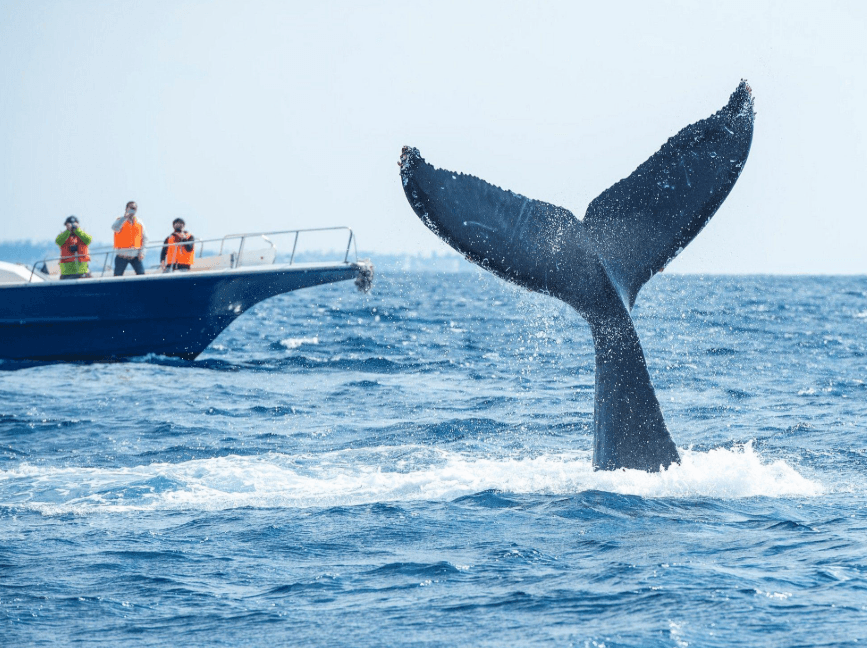
Samaná Bay offers visitors an opportunity to observe humpbacks during this period. Boats may encounter adult whales, mother-calf pairs, and other animals engaged in different activities.
However, seeing a mother and calf does not mean the calf was born at the exact location where the pair is observed. A calf may have been born elsewhere in the wider breeding region before the mother moved through the area.
Why give birth in warmer waters?
Scientists commonly associate humpback breeding and calving migrations with warm-water habitats and seasonal reproductive behavior. The full evolutionary reasons behind the use of particular breeding areas are complex and continue to be studied.
It is important not to assume that every birth takes place in a sheltered bay or that every female returns to the same exact location each year.
4. How Does a Humpback Whale Give Birth Underwater?
Humpback whales deliver their calves in the water. Researchers have documented aspects of cetacean birth, but the full process is difficult to observe in wild whales because births are rare, often occur underwater, and may take place far from researchers.
Like other cetaceans, humpback whales generally deliver their calves tail-first. This orientation is thought to help reduce the risk of the newborn attempting to breathe before it has fully emerged from the mother.
The precise sequence and duration of an individual birth can vary. It would be misleading to suggest that every humpback birth follows an identical timeline.
What happens during delivery?
During labor, the calf moves through the birth canal and emerges into the surrounding water. Once delivered, the newborn must begin moving toward the surface to breathe air.
Unlike a human baby, a whale calf cannot remain underwater indefinitely while recovering from birth. It must surface to take its first breaths.
A mother may help by staying close and supporting the calf's movement, but scientists should not assume that every mother assists in exactly the same way.
5. What Happens When a Humpback Whale Calf Is Born?
The first moments after birth are critical because the newborn must begin breathing air and swimming in the ocean.
The calf reaches the surface
A newborn humpback calf must surface to breathe through its blowholes. Whales are mammals and breathe air with lungs; they do not extract oxygen from water using gills.
The calf's initial movements may be less coordinated than those of an adult. Nevertheless, it needs to reach the surface and establish a breathing rhythm.
The calf begins swimming
Newborn calves are capable of swimming, although their coordination and strength continue to develop. Remaining close to the mother helps the calf stay near a source of milk and protection.
The ocean presents many challenges to a newborn, including maintaining position, moving efficiently, and coordinating surfacing with breathing.
The mother and calf remain closely associated
After birth, a calf generally stays close to its mother. This association is important because the mother provides milk and helps protect the young animal during its early development.
The first hours and days are only the beginning of a much longer period of growth. A calf needs time to build strength, improve swimming ability, and develop the skills required for independent life.
6. How Big Is a Newborn Humpback Whale?
A newborn humpback whale is already a large animal compared with most mammals on land.
Newborn calves are commonly around 4–5 meters (13–16 feet) long, although size varies. They may weigh roughly 1–2 tonnes, with estimates differing by population and individual.
A calf's size is one reason the birth process is so remarkable: a mother delivers a newborn that is several meters long into the ocean, where it must begin swimming almost immediately.
These figures are approximate rather than fixed measurements. Researchers use observations and scientific data to estimate calf size, and individual calves may fall outside typical ranges.
7. How Does a Mother Help Her Newborn Calf?
The mother-calf relationship is essential to the calf's early survival. Although the details of birth are different from later care, the two stages are closely connected.
A mother provides milk that supplies the energy needed for rapid growth. She also remains near the calf, allowing it to swim alongside her and stay within a relatively protected position.
The calf gradually develops stronger swimming ability and becomes better coordinated. During this period, the mother must balance her own needs with the energy demands of supporting her young.
Humpback whale mothers may also have to navigate busy breeding areas where other whales are present. The surrounding environment, the mother's condition, and other factors can influence how the pair behaves.
To learn more about this later stage, see a dedicated guide to how humpback whale mothers care for their calves.
8. Can You Witness a Humpback Whale Giving Birth in Samaná Bay?
It is possible for births to occur in the wider breeding region visited by North Atlantic humpback whales, but witnessing an actual birth during a typical whale-watching trip is extremely unlikely.
Births are rare events to observe, and much of the process takes place underwater. Most visitors see whales surfacing, diving, moving through the bay, or swimming in mother-calf pairs rather than witnessing delivery.
A mother swimming close to a young calf may be a memorable sight, but the calf's age and birthplace cannot usually be determined from a brief boat encounter alone.
The main whale-watching season in Samaná generally runs from January through March. Exact whale presence varies, and sightings of particular behaviors cannot be guaranteed.
If you visit, choose an authorized operator that follows applicable whale-watching rules. Boats should maintain appropriate distances and avoid disrupting mothers and calves. Never ask a captain to approach a newborn or a mother-calf pair more closely for a photograph.
Frequently Asked Questions
Do humpback whales give birth tail-first?
Humpback whales generally deliver their calves tail-first, as is typical of cetaceans. This is thought to reduce the risk of the newborn trying to breathe before it has fully emerged.
How many calves does a humpback whale have at once?
A female generally gives birth to one calf at a time. Twin births are considered unusual.
How long does humpback whale labor last?
The duration can vary, and births in the wild are difficult to observe closely. There is no single reliable duration that applies to every humpback whale birth.
Can a newborn humpback whale breathe underwater?
No. Humpback whales breathe air through their blowholes. A newborn calf must reach the surface to breathe after birth.
How soon can a humpback whale calf swim?
A calf can swim soon after birth, although coordination and strength continue to develop. Staying near its mother is important during this early period.
Are humpback whales born in Samaná Bay?
Humpback whales give birth in the wider warm-water breeding region used by North Atlantic populations, which includes Caribbean waters. A calf seen in Samaná Bay may have been born elsewhere in the region, so its exact birthplace cannot generally be inferred from a sighting.
When is the best time to see humpback whale mothers and calves in Samaná?
The main seasonal whale-watching period is generally January through March. The timing of individual births and sightings varies, and seeing a mother with a calf is never guaranteed.
Final Thoughts
Humpback whale birth is an extraordinary biological process. After approximately 11 months of pregnancy, a female generally delivers a live calf in the water. The newborn must surface to breathe, begin swimming, and stay close to its mother as it starts life in the ocean.
For visitors to Samaná Bay, understanding this process adds context to the sight of a mother swimming alongside her calf. Such an encounter offers a glimpse into a vulnerable early stage of a whale's life, even when the actual birth happened elsewhere.
The best way to appreciate these animals is to observe them responsibly, allow them space, and remember that every mother-calf pair is part of a much larger natural cycle.

Local explorer & expert guide in Whales of Samaná.