Do Humpback Whales Have a Sense of Touch?
Humpback whales are famous for their haunting songs, spectacular breaches, and long seasonal migrations. However, another aspect of their lives is less familiar to many people: how they experience physical contact with the world around them.
Like other mammals, humpback whales have sensory systems that allow them to detect aspects of their surroundings. Touch may play a role when whales come into physical contact with one another, interact with their calves, or encounter objects in the water. Yet, compared with whale vocalizations and migration patterns, the details of their tactile abilities remain less thoroughly understood.
For travelers visiting Samaná Bay in the Dominican Republic, learning about this subject offers another way to appreciate humpback whales beyond the moments when they rise above the ocean surface.
Do Humpback Whales Have a Sense of Touch?
Yes. Humpback whales are mammals, and their bodies contain sensory structures associated with detecting physical stimuli. Their skin and underlying tissues can provide information about contact and other mechanical sensations.
However, scientists cannot directly ask a whale what a particular sensation feels like. Researchers must study anatomy, behavior, and physiological evidence to understand how whales perceive their surroundings.
Touch is also different from hearing. Whale sounds can travel considerable distances underwater, allowing whales to communicate and detect acoustic information beyond their immediate surroundings. Touch, by contrast, generally involves direct physical contact or mechanical stimulation of the body.
Although the precise role of touch in every humpback whale behavior is not fully established, physical interactions provide valuable opportunities for researchers to investigate this sensory system.
How Does a Humpback Whale Detect Physical Contact?
A whale's body is covered by skin that protects its internal tissues. Beneath the skin are nerves and other structures that can transmit sensory information.
In mammals, sensory nerve endings help detect different forms of stimulation, including pressure and movement of the skin. Cetaceans have specialized bodies adapted to aquatic life, so researchers must consider their anatomy rather than assume that every aspect of their touch works exactly like that of humans.
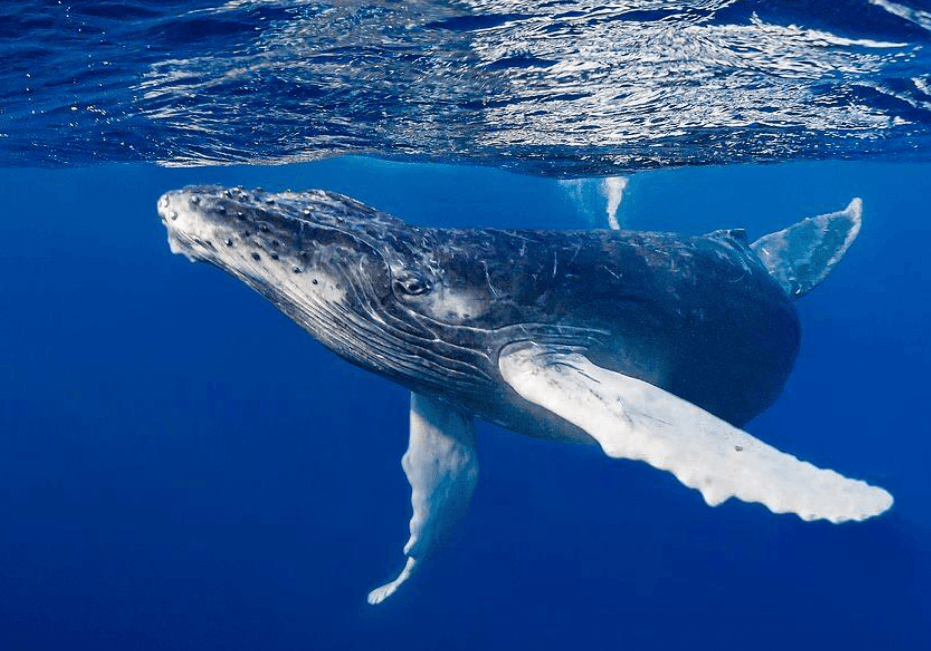
Humpback whales also have distinctive features on their heads, including raised bumps called tubercles. These bumps contain specialized structures associated with sensory functions, including prominent hairs or hair follicles in some tubercles. Their exact contributions to tactile perception and other sensory processes remain an area of scientific interest.
It is important not to assume that every bump on a whale's body serves as a touch receptor. Whale anatomy is complex, and different structures may have different functions.
Why Might Touch Matter Between a Mother and Her Calf?
The relationship between a humpback whale mother and her calf is one of the most important interactions observed in Samaná Bay during breeding season.
Calves remain close to their mothers while they nurse, swim, and learn behaviors needed for survival. Their proximity also allows them to coordinate movement and remain together in a dynamic ocean environment.
Physical contact may provide additional sensory information during these interactions. A calf swimming against or alongside its mother can experience contact with her body, while close positioning helps maintain their association.
However, observing two whales swimming closely together does not prove that touch is the primary purpose of their behavior. Their positioning may also relate to swimming efficiency, protection, nursing, or other factors.
Researchers continue to investigate the different signals and behaviors that help whale mothers and calves maintain contact and coordinate their activities.
Do Humpback Whales Touch Other Whales?
Humpback whales sometimes engage in close physical interactions with other whales. Depending on the context, these encounters can involve body contact, contact between fins, or movements that bring individuals close together.
During the breeding season, males may compete for access to females. Interactions within groups can include forceful movements and physical contact, although not every close encounter is aggressive.
Whales may also swim near one another without making direct contact. Distance, body orientation, speed, and changes in position can all provide useful information when scientists observe these interactions.
It is difficult to assign a single meaning to every instance of contact. The same visible behavior may have different explanations depending on the individuals involved and the circumstances.
For this reason, scientists consider the broader behavioral context instead of interpreting physical contact as proof of affection, aggression, or another specific emotional state.
Can Humpback Whales Feel Objects in the Water?
Humpback whales live in an environment filled with moving water, changing currents, prey, and other marine organisms. Their bodies encounter physical forces as they swim, turn, dive, and feed.
Touch and related mechanical sensory processes may help them detect direct contact with objects or other animals. Nevertheless, many aspects of their underwater environment can be detected through senses other than touch.
For example, hearing provides information about underwater sounds, while vision can contribute to observing nearby animals and surroundings under suitable conditions. Water movement and pressure also create physical signals, but the exact sensory mechanisms used to detect particular signals can differ among cetacean species.
It would therefore be inaccurate to suggest that humpback whales rely on touch alone to navigate or understand their environment.
Is a Humpback Whale's Skin Sensitive?
Whale skin is more than an outer covering. It forms part of a living organ system that protects the animal and interacts with the environment.
Sensory nerves in the skin and underlying tissues can contribute to the detection of physical stimuli. However, sensitivity may vary across body regions, and researchers do not have a complete map of how every part of a humpback whale's body responds to every kind of contact.
Scientists also study the structure and condition of whale skin to learn about health, injuries, parasites, and environmental exposure. These investigations can reveal important details about whale biology, although skin appearance alone does not tell observers exactly what an animal is feeling.
For responsible wildlife watching, the most important lesson is that a whale's body should be treated as living tissue, not as a surface for human contact.
How Do Scientists Study Touch in Humpback Whales?
Studying tactile perception in large, free-swimming whales presents significant challenges. Researchers cannot easily conduct controlled experiments with wild humpbacks, and invasive procedures would raise serious welfare concerns.
Instead, scientists can combine several lines of evidence.
1. Anatomical research
Examinations of naturally available specimens and carefully collected scientific material can help researchers understand skin structure, sensory nerves, hair follicles, and other relevant features.
2. Behavioral observations
Researchers document how whales behave during interactions with calves, other adults, and their environment. Video footage can help reveal the sequence of movements and whether physical contact occurs.
3. Comparative biology
Scientists compare humpback whales with other cetaceans and mammals. These comparisons can generate hypotheses about sensory function, but findings from one species should not automatically be applied to another.
4. Non-invasive technology
Photography, underwater video, and other observation tools can help scientists document interactions without directly handling the animals.
Together, these methods can improve scientific understanding. Nevertheless, some questions about the subjective experience of touch in humpback whales may remain difficult to answer.
Can Visitors Observe Touch-Related Behavior in Samaná Bay?
Samaná Bay is well known for seasonal humpback whale watching, particularly during the winter breeding period in the North Atlantic. Visitors may observe whales surfacing, traveling together, raising their flukes, or swimming near one another.
On some trips, observers may see a mother and calf moving closely together or multiple whales interacting near the surface. Such sightings can prompt interesting questions about physical contact and social behavior.
However, a boat-based observation usually cannot reveal every detail of what happens underwater. Even when two whales appear close together, it may be impossible to determine whether they are touching or why they are positioned that way.
The best approach is to watch patiently, listen to the guide's explanation, and distinguish visible evidence from possible interpretations.
For more information about planning a visit, explore a dedicated Samaná whale-watching guide and check current tour arrangements before traveling.
Why Responsible Whale Watching Matters
Understanding how whales sense their surroundings reinforces the importance of giving them space. Approaching too closely can disturb natural behavior, particularly when mothers and calves are traveling together.
Choose operators that follow applicable whale-watching regulations and local guidance. Follow the captain's instructions, avoid attempting to touch whales, and never enter the water to approach them unless a specific activity is legally authorized and appropriately managed.
Responsible observation allows visitors to appreciate these animals without interfering unnecessarily with their behavior.
Frequently Asked Questions
Do humpback whales enjoy being touched?
Scientists cannot reliably determine whether a particular touch is pleasurable to a wild humpback whale. Human interpretations of whale behavior should not be treated as proof of the animal's emotional experience. People should never attempt to touch wild whales.
Do humpback whale calves touch their mothers?
Calves and mothers swim in close proximity, and physical contact may occur during their interactions. The purpose of any particular contact depends on the circumstances and should not be assumed from proximity alone.
Are humpback whales sensitive to touch?
Their anatomy supports the presence of sensory systems capable of detecting physical stimuli. The precise distribution and function of tactile sensitivity across the body are not fully understood.
Do whales use touch to communicate?
Physical contact may provide information during close interactions, but humpback whales also use acoustic signals and visible behaviors. The exact role of touch in their communication remains less clearly understood than some aspects of their vocal behavior.
Can I see whales touching during a Samaná whale-watching tour?
It is possible to observe close interactions, but direct contact is not guaranteed. Sightings depend on whale behavior, sea conditions, and the particular trip.
Final Thoughts
The sense of touch offers another perspective on humpback whale biology. Their skin, sensory structures, and physical interactions provide researchers with clues about how these large marine mammals experience direct contact with their surroundings.
In Samaná Bay, observing whales responsibly can inspire visitors to look beyond spectacular breaches and tail displays. Close swimming, mother-calf interactions, and other behaviors are opportunities to ask thoughtful questions while recognizing the limits of what can be inferred from a brief sighting.
The more we learn about humpback whales, the more important it becomes to protect their natural behavior and observe them with patience and respect.

Local explorer & expert guide in Whales of Samaná.