How Do Humpback Whales Breathe Blowholes and Diving Explained
Humpback whales spend most of their lives in the ocean, but they cannot breathe underwater like fish. These enormous marine mammals must come to the surface to take in air before diving beneath the waves again.
If you visit Samaná Bay in the Dominican Republic during whale-watching season, you may see a humpback whale rise to the surface and release a misty plume from the top of its head. This familiar sight is often called a whale's blow, and it is one of the clearest signs that the animal is breathing.
But how do humpback whales breathe How do their blowholes work, and how long can they remain underwater?
Humpback whales have specialized respiratory systems that allow them to exchange air quickly at the surface, store oxygen in their bodies, and remain submerged while diving. Their breathing adaptations are essential to their survival in the marine environment.
This guide explains how humpback whales breathe, why they have blowholes, how breathing differs from that of humans, and what visitors can learn by observing whales in Samaná Bay.
Do Humpback Whales Breathe Air?
Yes. Humpback whales are mammals, not fish, so they breathe atmospheric air using lungs.
Fish generally obtain dissolved oxygen from water through their gills. Humpback whales cannot do this. They must rise to the surface and breathe through openings on top of their heads.
Their respiratory system has evolved to support life in the ocean, where they alternate between breathing at the surface and diving underwater.
Like other mammals, humpback whales use oxygen to support their muscles, brain, and other organs. Their bodies are adapted to make efficient use of the oxygen available during a dive.
This adaptation allows them to travel beneath the surface without taking a breath every few seconds. However, every dive eventually ends with a return to the surface for air.
What Is a Humpback Whale's Blowhole?
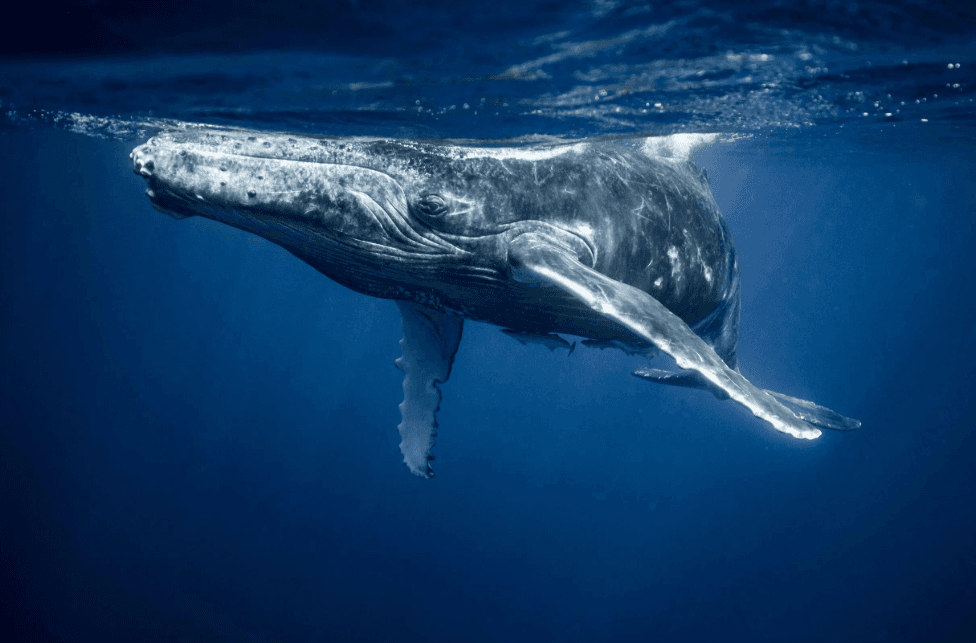
A humpback whale's blowholes are openings located on top of its head. They connect to the respiratory system and allow the whale to exchange air when it surfaces.
Unlike toothed whales, which generally have one external blowhole, humpback whales are baleen whales and have two blowholes.
Their position on top of the head is useful because the whale does not need to lift its entire body out of the water to breathe. It can bring the blowholes above the surface while most of its body remains submerged.
How do the blowholes work?
When a humpback whale reaches the surface, it opens its blowholes to exhale and inhale. Muscular control helps keep the openings closed underwater, reducing the risk of water entering the respiratory passages.
The whale can then dive again with its blowholes closed.
This arrangement is different from human breathing through the nose and mouth. Humans breathe through openings on the face, while humpback whales have specialized openings on the top of the head that suit their aquatic lifestyle.
Why do humpback whales have two blowholes?
The two openings are part of the respiratory anatomy of baleen whales. They allow air to pass between the whale's respiratory passages and the outside environment.
Although both openings may be involved in breathing, the visible appearance of a whale's blow can vary. The shape, direction, and visibility of the plume depend on several factors, including the animal's position and the surrounding conditions.
The presence of two blowholes does not mean that humpback whales can breathe underwater. They still need atmospheric air.
What Is the Mist That Comes Out of a Whale's Blowhole?
One of the most recognizable sights during whale watching is the plume that appears when a whale surfaces.
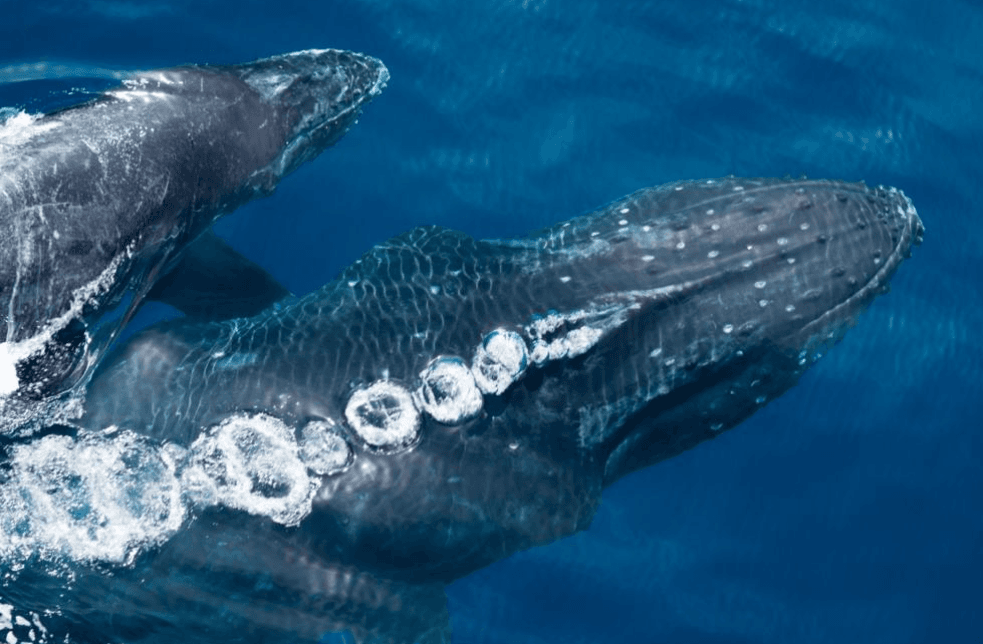
People often call this a water spout, but the visible plume is primarily warm, moist air from the whale's respiratory system. When that air meets the cooler surrounding atmosphere, some of its moisture condenses into tiny droplets, creating a visible cloud.
The plume may also contain droplets of seawater from around the blowholes.
Is a whale spraying water into the air?
Not in the way a fountain sprays water. The plume is associated with the whale's forceful exhalation, and much of the visible cloud consists of condensed moisture.
Its shape and height can change with weather, viewing angle, and the whale's breathing behavior. A large-looking plume does not necessarily indicate that the whale is distressed or in danger.
For visitors in Samaná Bay, seeing a plume can help reveal where a whale has surfaced. The whale may take another breath before diving again.
However, a plume is only one part of a larger breathing process, and not every surfacing will produce a clearly visible cloud.
How Do Humpback Whales Breathe Underwater?
Humpback whales do not breathe underwater. Instead, they hold their breath while submerged.
Before diving, a whale takes in air at the surface. It then closes its blowholes and descends into the water.
During the dive, its body uses oxygen already available in its lungs, blood, and muscle tissue. Specialized physiological adaptations help marine mammals manage oxygen use and conserve it while underwater.
As the dive continues, the whale eventually needs to return to the surface to breathe again.
How do whales conserve oxygen?
Several adaptations help whales remain underwater during dives:
- Oxygen storage: Their blood and muscles can store substantial amounts of oxygen.
- Efficient oxygen use: Physiological responses help manage the supply of oxygen to different tissues during a dive.
- Controlled activity: Changes in movement and metabolism can help limit energy expenditure during some dives.
- Diving responses: Heart rate and blood circulation can adjust during submersion, helping manage oxygen use.
The precise response varies with the animal's activity and circumstances. A whale swimming actively may use oxygen differently from one making a less demanding dive.
These adaptations are important, but they do not allow whales to remain underwater indefinitely.
How Long Can Humpback Whales Stay Underwater?
Humpback whales can remain underwater for several minutes, and some dives can last longer depending on the activity and circumstances.
There is no single dive duration that applies to every humpback whale. Dive length can vary according to behavior, activity, environmental conditions, and the individual animal.
A whale traveling between locations may have a different dive pattern from one feeding in a suitable feeding habitat. A whale seen in Samaná Bay during the breeding season may also behave differently from one observed elsewhere.
Why do humpback whales sometimes disappear for a long time?
After surfacing, a humpback whale may take a breath and then dive again. It can travel underwater beyond the area visible from a boat, making it seem as though it has disappeared.
The whale may return to the surface at a different location. Its absence does not necessarily indicate a problem.
This is a normal part of whale watching: visitors may see a plume, watch the animal's back move through the water, and then wait while it remains submerged.
The exact duration of the next dive cannot be predicted reliably from one brief observation.
How Often Do Humpback Whales Need to Breathe?
Humpback whales do not breathe continuously while underwater. They breathe when they surface, then remain submerged during a dive.
The time between breaths varies according to what the whale is doing. It may take several breaths during a surface interval before diving again, or it may surface briefly and descend.
There is no universal schedule that applies to all humpback whales.
Researchers studying whale breathing must account for the animal's behavior, the conditions in which it is observed, and differences between individuals.
For whale watchers, the most useful thing to remember is that surfacing and diving are normal parts of a humpback whale's routine. A whale that disappears beneath the surface is often simply continuing its natural activity.
Can Humpback Whales Breathe While Sleeping?
Humpback whales must continue managing their breathing even during periods of rest. Unlike humans, cetaceans have strong voluntary control over breathing, and their resting biology is adapted to life in water.
A resting whale cannot simply remain underwater without eventually returning to the surface for air.
However, the precise organization of sleep and breathing in wild humpback whales is still an area of scientific investigation. Findings from other marine mammals can help scientists form hypotheses, but they should not automatically be treated as proof of exactly how humpback whales sleep.
A whale floating quietly near the surface is not necessarily asleep. It could be resting, moving slowly, or simply remaining near the surface between dives.
How Is Whale Breathing Different From Human Breathing?
Humans and humpback whales are both mammals, so they share fundamental features of respiratory biology. Both use lungs to take in oxygen from the air and release carbon dioxide.
The major difference is how breathing fits into their environment.
Humans can breathe while standing, walking, or sleeping on land without consciously returning to a separate breathing location. Humpback whales live in water and must reach the surface whenever they need air.
FeatureHumansHumpback whalesRespiratory organsLungsLungsMain breathing openingsNose and mouthTwo blowholesCan extract oxygen from water with gills?NoNoMust reach the surface to breathe?No, on landYesCan hold their breath while diving?Yes, for limited periodsYes, with specialized diving adaptations
The comparison shows that whales are not fish-like breathers despite spending their lives in water. They are air-breathing mammals that have evolved to dive efficiently.
What Can You Learn From Whale Breathing During a Samaná Tour?
Samaná Bay in the Dominican Republic is known for seasonal visits by North Atlantic humpback whales. During whale-watching excursions, visitors may observe whales surfacing, exhaling, taking breaths, and diving again.
Watching this sequence can provide a simple introduction to whale respiratory biology.
Look for the breathing sequence
A whale may first reveal its blow, followed by the curve of its back as it moves through the water. It may surface again for additional breaths before beginning another dive.
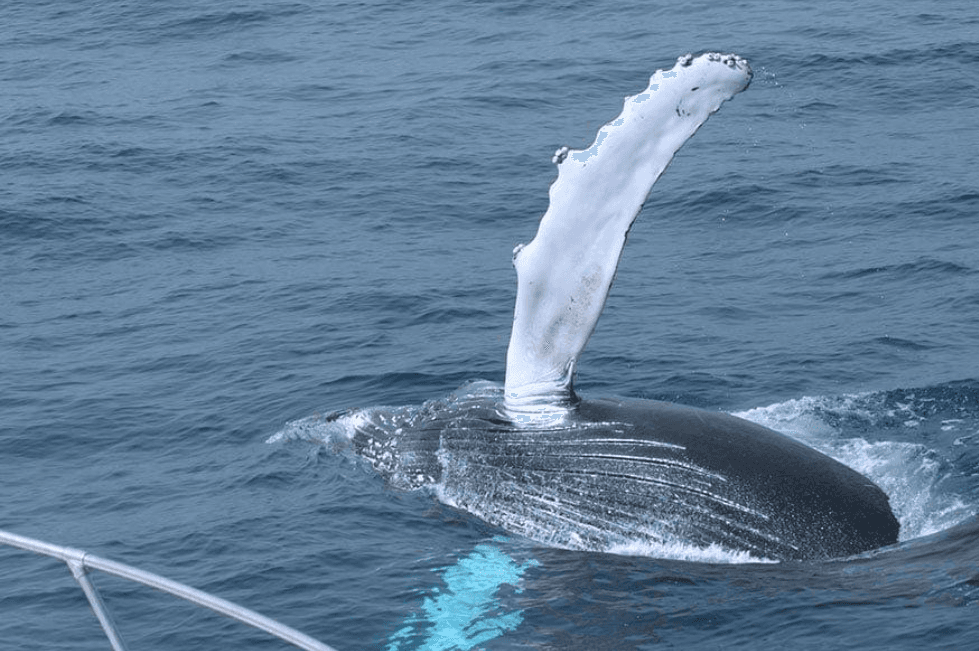
Sometimes the whale's tail flukes rise above the surface before a dive, but this behavior does not occur during every encounter.
The timing and visibility of each movement vary. Visitors should not expect every whale to follow the same sequence.
Why do whales disappear after surfacing?
Whales often dive after breathing. They may travel underwater for a period before surfacing again, sometimes beyond the immediate viewing area.
This is normal behavior and does not mean the whale has necessarily left the region.
What should visitors do?
Follow the guide's instructions, stay in the designated passenger area, and avoid attempting to approach a whale independently.
Responsible operators should follow applicable wildlife-viewing rules and avoid deliberately chasing, crowding, or disturbing whales.
Understanding whale breathing can make a tour more educational, but the animals should always be observed on their own terms.
Frequently Asked Questions
Do humpback whales breathe through their mouths?
No. Humpback whales breathe through the blowholes on top of their heads. Their mouths are involved in feeding, not normal breathing.
Do humpback whales have lungs?
Yes. They have lungs like other mammals and must surface to take in atmospheric air.
How many blowholes does a humpback whale have?
Humpback whales have two blowholes, a characteristic of baleen whales.
Can humpback whales drown?
Yes. Because they depend on air, whales can drown if they cannot reach the surface to breathe. Their diving adaptations help them manage underwater activity but do not remove this risk.
Is the whale's blow made entirely of water?
No. The visible plume is mainly warm, moist air that condenses in the surrounding atmosphere, although droplets of seawater may also be present.
Can humpback whales breathe while diving?
No. They hold their breath underwater and return to the surface when they need to exchange air.
Can you see humpback whales breathing in Samaná Bay?
Yes, visitors may see whales surface and release a visible plume during whale-watching trips in the region's whale season. Sightings and visible behaviors are never guaranteed.
Conclusion
Humpback whales breathe air through two blowholes on top of their heads. They surface to exhale and inhale, then close their blowholes before diving beneath the water.
Their lungs, oxygen-storage capacity, and diving responses help them remain submerged for several minutes or longer, depending on the circumstances. Nevertheless, they cannot breathe underwater and must return to the surface for air.
For visitors to Samaná Bay, watching a humpback whale surface and breathe is more than a memorable wildlife encounter. It is an opportunity to see how a mammal has adapted to life in the ocean.
By understanding this process and observing whales responsibly, travelers can develop a greater appreciation for these remarkable animals and the marine environment they inhabit.

Local explorer & expert guide in Whales of Samaná.