How Underwater Noise Affects Humpback Whales
The ocean may look peaceful from the surface, but underwater it is filled with sound. Waves, rain, marine animals, and moving water all contribute to the natural acoustic environment. Human activities add another layer of sound, including noise from boats, commercial ships, construction, and certain industrial operations.
For humpback whales, sound is an important part of life. These marine mammals produce vocalizations and can use acoustic information to communicate in an environment where visibility is often limited.
Understanding underwater noise helps explain why responsible whale watching matters. In Samaná, Dominican Republic, where humpback whales gather seasonally, reducing unnecessary disturbance is an important part of protecting these remarkable animals.
This guide explores how sound travels underwater, why it matters to humpback whales, and what travelers can do to support quieter, more responsible wildlife encounters.
Why Is Sound Important Underwater?
Sound travels differently through water than it does through air. In many circumstances, sound travels efficiently underwater, allowing acoustic signals to carry across distances that depend on frequency, water conditions, background noise, and the surrounding environment.
For marine mammals, this creates opportunities to exchange information even when they cannot see one another.
Humpback whales produce a range of sounds, including songs and other vocalizations. Researchers study these sounds to investigate communication, social behavior, and patterns of acoustic activity.
Sound is not the only source of information whales use. They also respond to their physical surroundings and other sensory cues. However, acoustic information is particularly important in the marine environment.
When additional noise enters the water, it can change the acoustic conditions in which whales communicate and detect sounds.
What Causes Underwater Noise?
Underwater noise comes from both natural processes and human activities. Natural sounds are part of the marine environment, while human-generated noise can introduce additional sound that changes the local acoustic landscape.
Boat engines
Engines and propellers generate underwater sound. The amount and characteristics of that sound depend on the vessel, engine, propeller, operating speed, maintenance, and other factors.
Whale-watching boats are one potential source of human-generated noise in areas where tourism takes place. Responsible operation can help reduce unnecessary disturbance.
Commercial shipping
Large commercial vessels can contribute substantial underwater noise, particularly in busy shipping routes.
Because shipping activity may occur across broad marine areas, its acoustic effects can extend beyond a single boat's immediate surroundings.
Construction and industrial activity
Some underwater construction and industrial operations generate intense sounds. Depending on the activity, location, and duration, these sounds may affect marine animals over different distances.
Such activities are distinct from ordinary whale-watching trips, but they illustrate the range of human-generated sound entering the ocean.
Other sources
Sonar systems and certain research or industrial activities can also produce underwater sound. Their effects depend on the equipment, frequency, intensity, duration, and context of use.
It is important to distinguish between different sound sources rather than assuming that all underwater noise has the same effect on whales.
How Underwater Noise Can Affect Humpback Whales
The effects of underwater noise depend on the sound itself and the circumstances in which a whale encounters it. Scientists investigate several possible pathways through which noise can influence marine mammals.
Masking communication
Acoustic masking occurs when background noise makes another sound more difficult to detect.
For humpback whales, additional noise may make some vocalizations harder to hear under particular conditions. The extent of this effect depends on the frequencies involved, the distance between animals, and the surrounding acoustic environment.
Masking does not mean that all communication stops. Its impact varies with the type and level of noise and how whales respond.
Changes in behavior
Whales may alter their behavior when exposed to certain sounds. Depending on the situation, responses can include changes in vocal activity, swimming patterns, movement away from a sound source, or other behavioral adjustments.
Not every whale reacts in the same way, and a visible response does not necessarily reveal the full effect of a sound.
Researchers therefore study both immediate behavioral changes and the broader context in which they occur.
Stress and disturbance
Repeated or intense noise exposure may create additional challenges for marine mammals. The possible effects depend on the exposure's intensity, duration, frequency, and the animal's circumstances.
Scientists investigate these relationships to better understand how acoustic disturbance may affect individual animals and populations.
It would be misleading to assume that every passing boat causes measurable stress or that every sound produces harm. The goal is to identify and reduce avoidable risks using the available evidence.
Hearing-related risks
Very intense sounds can pose hearing risks to marine mammals under certain conditions. The likelihood and severity depend on factors such as sound level, frequency, distance, and exposure duration.
Ordinary observations from a whale-watching boat do not allow passengers to determine whether a whale has experienced hearing damage. Such effects require appropriate scientific assessment.
Do Humpback Whales Change Their Songs Because of Noise?
Humpback whale songs are complex vocal sequences that researchers study across breeding and feeding regions.
Acoustic conditions can influence how well songs are detected and recorded. In some circumstances, whales may adjust aspects of their vocal behavior when background noise changes.
However, changes in recorded sound do not always mean the whales themselves have changed their songs. A microphone may capture different details simply because the background noise, recording distance, or equipment has changed.
Researchers must distinguish between changes in the animal's behavior and changes in the quality of the recording.
Humpback whale songs also vary naturally. Their acoustic behavior can change over time and between contexts, so noise should not automatically be treated as the explanation for every observed difference.
Understanding these distinctions is important when interpreting whale research.
Why Underwater Noise Matters During Whale Watching in Samaná
Samaná is a well-known destination for observing North Atlantic humpback whales during their seasonal presence in the Dominican Republic.
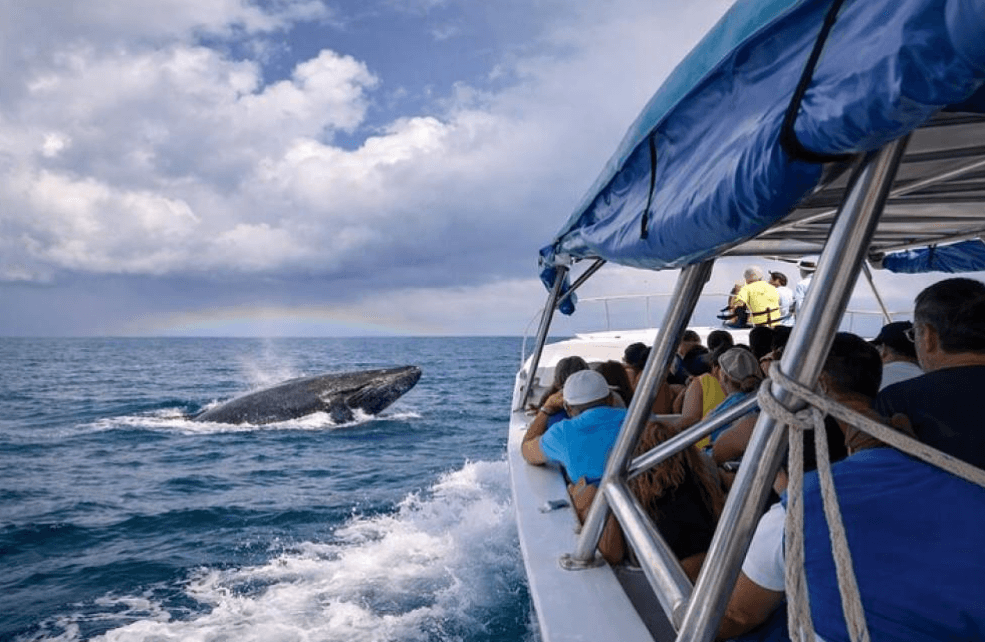
Whale-watching excursions provide opportunities to observe these animals in their natural environment. However, boats are also part of the acoustic environment that whales experience.
Responsible operators should follow applicable regulations, maintain appropriate distances, avoid aggressive pursuit, and operate vessels carefully around wildlife.
The aim is not to eliminate every sound from the ocean. That would be impossible. Instead, responsible whale watching seeks to minimize unnecessary disturbance while allowing visitors to observe whales safely.
Travelers can support this approach by choosing reputable operators and following the crew's instructions throughout the excursion.
A respectful encounter gives whales space to move naturally without pressure from boats trying to obtain a closer view.
How Scientists Study Underwater Noise
Researchers use specialized equipment to investigate underwater sound and its relationship with marine mammals.
Hydrophones
A hydrophone is an underwater microphone designed to record sound in the water. Researchers use hydrophones to study whale vocalizations, background noise, and changes in the acoustic environment.
Hydrophones can be deployed from research vessels, fixed monitoring stations, or other suitable platforms.
Acoustic recordings
Scientists analyze recordings to investigate the timing, frequency, and characteristics of sounds. These analyses can help identify patterns in whale vocal activity and changes in background noise.
The quality of the recording, equipment settings, and location must be considered when interpreting results.
Behavioral observations
Researchers may combine acoustic recordings with visual observations, photographs, or other monitoring methods.
This approach can help investigate whether whales change their behavior when noise levels or sound sources change.
Long-term monitoring
Repeated measurements can reveal patterns that are difficult to detect from a single observation. Long-term data may help researchers distinguish normal variation from changes associated with particular human activities.
No single method answers every question. Combining acoustic and behavioral evidence generally provides a stronger basis for understanding potential impacts.
How Whale-Watching Operators Can Reduce Noise Disturbance
Responsible vessel operation can help limit unnecessary acoustic disturbance.
Useful practices include:
- Maintaining appropriate distances from whales according to local regulations.
- Avoiding sudden or aggressive maneuvers around animals.
- Following designated wildlife-observation procedures.
- Keeping engines and other equipment properly maintained.
- Avoiding unnecessary vessel activity near whales.
- Respecting official instructions when wildlife behavior or sea conditions require changes to the trip.
These measures do not make a vessel silent. They help promote safer, more considerate encounters.
Operators should follow the regulations and guidance applicable to the specific whale-watching area rather than relying on a single distance or operating rule for every situation.
What Visitors Can Do to Protect Whales
Travelers also play a role in responsible wildlife tourism.
Before booking a trip, ask how the operator approaches whales and what rules are followed during sightings. Choose a company that prioritizes animal welfare rather than promising close encounters or guaranteed photographs.
During the excursion, remain seated or in designated areas when instructed, listen to the crew, and never encourage the captain to pursue a whale for a better view.
You can also learn about the marine environment before your visit. Understanding the role of sound makes it easier to appreciate why careful boat handling and respectful observation matter.
If an operator explains that a whale should be left undisturbed or that a sighting must be approached cautiously, respect that decision. The welfare of the animal should take priority over a photograph.
Frequently Asked Questions
Can humpback whales hear boats underwater?
Humpback whales can detect underwater sounds, including sounds generated by vessels. The frequencies they hear and the effects of particular sounds depend on the animal and the acoustic conditions.
Does every whale-watching boat harm whales?
Not every encounter produces the same effects. Potential disturbance depends on factors such as vessel noise, distance, duration, and whale behavior. Responsible operation helps reduce unnecessary risks.
Can underwater noise prevent whales from communicating?
Noise can mask some sounds under certain conditions, making them more difficult to detect. The degree of interference depends on the sound source, frequency, and surrounding environment.
Are humpback whale songs affected by noise?
Background noise can affect how songs are heard and recorded. Whales may also change aspects of their vocal behavior in some situations, but scientists must distinguish these responses from natural variation and recording limitations.
How can I choose a responsible whale-watching tour in Samaná?
Look for an operator that follows local regulations, respects wildlife-observation distances, avoids aggressive pursuit, explains safety procedures, and places animal welfare ahead of close-up encounters.
Final Thoughts
Underwater sound is a natural part of ocean life, but human activities can change the acoustic environment in which humpback whales live and communicate.
The effects vary with the sound source, exposure, and circumstances. Research into acoustic masking, behavioral responses, and other possible impacts helps scientists understand where disturbance may occur and how it can be reduced.
For visitors to Samaná, the practical lesson is simple: choose responsible whale-watching operators, respect wildlife guidelines, and allow whales to move freely without unnecessary pressure.
A memorable wildlife encounter should not come at the expense of the animals being observed. By supporting thoughtful tourism and marine research, travelers can help encourage better protection of humpback whales and their ocean environment.

Local explorer & expert guide in Whales of Samaná.